In a guest post, our patron and leading castle expert Dr Edward Impey You can learn more about other aspects of castles as well as portcullises in his newly published book, English Castles, published by Liverpool University Press.
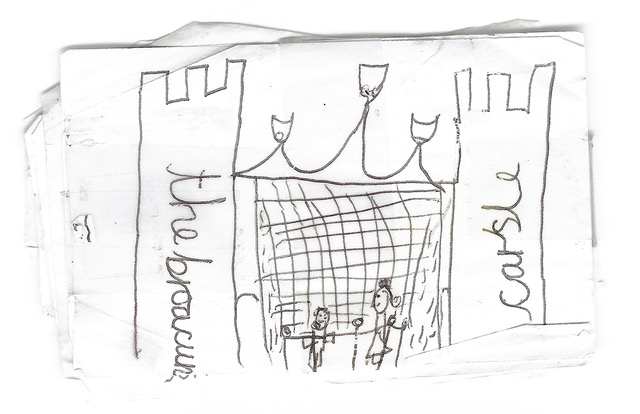
Along with battlements and arrow-loops the toothy grille of the portcullis is a detail clearly spelling ‘castle’ in medieval images, heraldry, modern illustrations, cartoons, film sets and children’s drawings. But however well-known and familiar as a motif, aspects of the structure and even the function of portcullises, known to us today almost exclusively from the grooves surviving in the stone side-walls of gateways, remain poorly understood.
Subscribe to our quarterly newsletter
As with those other details, the portcullis has a long pedigree, stretching back to Antiquity and beyond. The earliest known English example may be in the great tower at Colchester, where the grooves clearly belong to the work of c.1080, although the gatehouse at Arundel, possibly as early as the 1070s, is a contender. They remain rare, however, for most of the 12th century, but towards its end appear in Alexander Neckam’s list of a castle’s essentials, and were soon to become a near-standard feature of defensible entrances: as he terms them, as in classical Latin, cataractae (waterfalls), although our word derives less picturesquely from the Old French, porte coleice, literally ‘sliding door’ (today porte coulissante); the alternative French term herse is borrowed from the wooden harrow which it closely resembles. As also with drawbridges, portcullises outlived the Middle Ages, appearing in Henry VIII’s ‘device’ forts and later still. In scale they ranged upwards from the ‘person-sized’, as found in the Marten Tower of 1288-93 at Chepstow, the great tower of Knaresborough (1307-12), and later in the century at Harewood, the halls at Kenilworth, Appleby and Egremont and the courtyard at Bolton. At the other extreme was the monstrous affair at least intended for St Thomas’s Tower (‘Traitor’s Gate’) at the Tower of London in the 1270s, an unwieldy 24ft (7.3m) wide, although perhaps never fitted: the grille we see there today is later and fixed. What we know of their construction begins of course with the grooves, generally 3-4 inches across: early ones are invariably square-backed, but from the early 13th century increasingly rounded at the rear, followed by a general reversion to square from about 1350. Whilst portcullises frequently appear in Medieval illustrations, carpentry detail does not, but fortunately a few actually survive. French examples include the Porte des Champs at Angers of 1373-84, and one of 1390-1404 at Blandy-les-Tours: in the British Isles the oldest is the Byward Tower portcullis at the Tower, completed for Edward I in or by 1281, still accompanied by functioning and part-contemporary winding gear. The latest medieval survivor is probably at Hever, in the boldly machicolated gatehouse of the 1380s. All these examples have grilles of strictly vertical and horizontal bars, but medieval images, such as formerly in the Painted Chamber at Westminster, occasionally show diagonal variants.
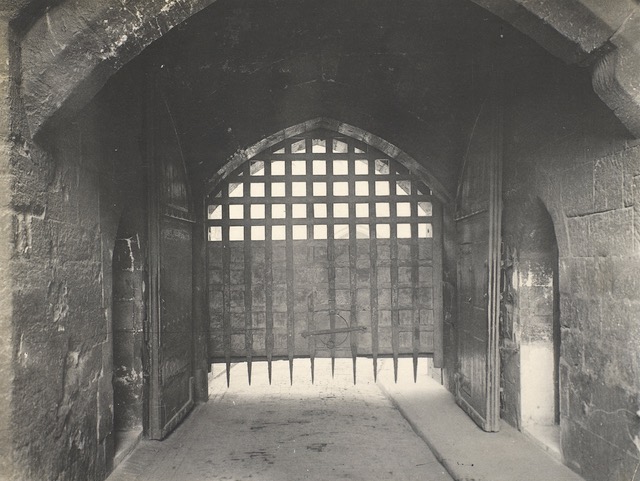
The survivors are assembled using halving-joints, mortices and tenons and/or lap-dovetails, nails, wedges and pegs, as in the rear framing of many medieval doors, along with iron reinforcements and spikes at the lower edge. The earliest ones, however, known from grooves as little as 6cm (2 ½ in) wide, may have been of solid boards to give them any useful strength: in a full-size portcullis the iron grilles confidently cited by some authors, would surely have been impossibly heavy. The design of their winding gear is more elusive still, confined usually to enigmatic holes in the associated masonry overhead, but fortunately at the Byward Tower the kit largely survives, an arrangement of ropes and a giant timber axle operated with capstan-bars. Something similar is to be found at Monk Bar, York, and there are other fragments elsewhere.
Subscribe to our quarterly newsletter
The physicality of the portcullis, however, is one thing, but why they were quite so beloved of the medieval castle-builder is less clear. And beloved they were, abundantly fitted, as has been seen, to entrances large and small, and frequently in multiples– six, for example, being intended for the King’s Gate at Caernarfon, and four at Beaumaris. This required considerable commitment, and as with any machinery, such as for drawbridges, raising water and grinding corn, portcullises were expensive, one retrofitted at White Castle in 1256-57 costing £1.7s, twenty-six times the cost of a set of gates installed at the same time. Although less prone to decay than the drawbridges, they also required careful maintenance. They were also immensely inconvenient, as along with their mechanisms they almost always obtruded into the rooms over the gateway, a natural site for an important room and in many cases a chapel.
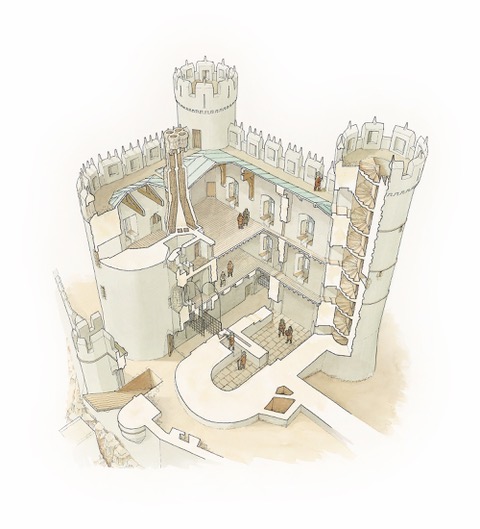
Clearly, portcullises had a defensive function. However, although often shielded by a raised drawbridge (although not gates, usually behind them), they were too fragile to resist artillery and medieval images suggest that in action they could be drawn up out of harm’s way. Practically, then, their role was essentially ‘anti-personnel’, allowing the near-instant closing of an entrance, and potentially trapping a rash intruder, cited as a useful function by the Roman author Vegetius. Recorded medieval instances, however, are rare, one being a failed attempt at Dunbar in 1338 to ensnare the commander of the English assailants. Medieval fiction, though contains at least one other, in Chrétien de Troyes’s Yvain ou le Chevalier au Lion of c.1180, in which the outer porte colanz of Esclados’s castle crashed down, killing Yvain’s horse and severing his spurs, while a second one trapped him in the gate passage. Fortunately for Yvain, however, he escaped, with the aid of a charming maiden and a magic ring.
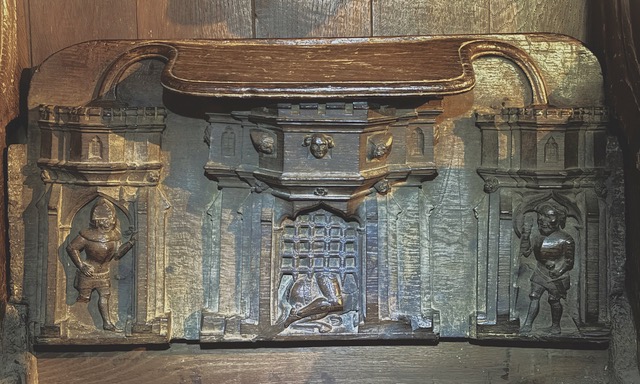
Defensively, a portcullis in the lowered position would also have allowed, unlike most gates, for a defending force to shoot at their assailants through it, although providing very little protection against return fire: a rare if later instance in which this was clearly anticipated is found once again at the Byward gate to the Tower, where the portcullis was pierced by a giant ‘cat-flap’ in the 1840s, allowing a grape-shot laden carronade to mow down revolting Chartists. To complicate things still further, though, some portcullises, must, bizarrely, have been of little practical value at all, as their grooves descend only to the springing of the gate arch, as at Château Gaillard, Alnwick, Bamburgh, Warkworth, Chepstow (Upper Gatehouse of 1270-1306), and the Queen’s Gate at Caernarfon.
The portcullis’s credentials as a straightforward piece of military hardware therefore had their limits. This leads us towards an explanation so often and so dangerously applied to castles as a whole, that their primary purpose was for effect, but for which the portcullis was supremely well equipped.
First, in the fanged and fearsome frontage the raised portcullis gave to an entrance. But what was perhaps their most important contribution, lost to us today bar in the handful of castles, such as Cahir in County Tipperary, where a re-created portcullis actually works, is the drama of their operation. Modern castle studies rightly drums into us the importance of ceremonial and effect, and the contribution of the portcullis to the rite of passage into a medieval castle, punctuated and announced with mighty clangs and bangs and muffled swearing must have been an impressive experience.
Subscribe to our quarterly newsletter
English Castles 1050-1450 by Dr Edward Impey, published by Liverpool University Press is available in all good book shops. You can learn more about it here: English Castles 1050-1450 | Home