Dutch Transcription and Translation December 2025 Update: Interpreting SP9/99

In their latest update Drs Paul Pattinson and Esther van Raamsdonk look at how far they have progressed with the transcription and translation of the Seventeenth Century survey of fortifications in southern England, revealing some pleasant surprises that have awaited them.

In our last update on Transcribing and Translating SP9/99: A Seventeenth-Century Dutch Survey of 22 English Castles and Fortifications, we concentrated on just that, the challenging process of transcription and translation of a difficult Dutch manuscript that uses unorthodox words (whose meaning is sometimes unknown), a note-like format, and a complete lack of punctuation. That process is now essentially complete, bar a few words that may be technical terms, and about which we are consulting with fortification experts in the Netherlands. However, we can now begin to interpret the manuscript and what it can tell us about the coastal artillery castles and bulwarks along the south-east and south coasts of England in the early seventeenth century.

Subscribe to our quarterly newsletter

After looking briefly at the whole manuscript of 23 folios (46 pages), we can now say that there are details of at least 29 fortifications, not just 23, and that may not be the final number. In due course we hope to establish a complete list. For the time being, the work for which we were generously grant-aided by the CST focussed on 9 folios covering 6 artillery castles, all of which were built or modified during the early stages of the ‘device’ programme of Henry VIII, between 1539 and 1541. We selected these as a suitable sample of the manuscript because historically they formed a discrete group in the jurisdiction of and under the command of the Lord Warden of the Cinque Ports: they are the castles at Sandown, Deal, Walmer, Dover, Sandgate and Camber.
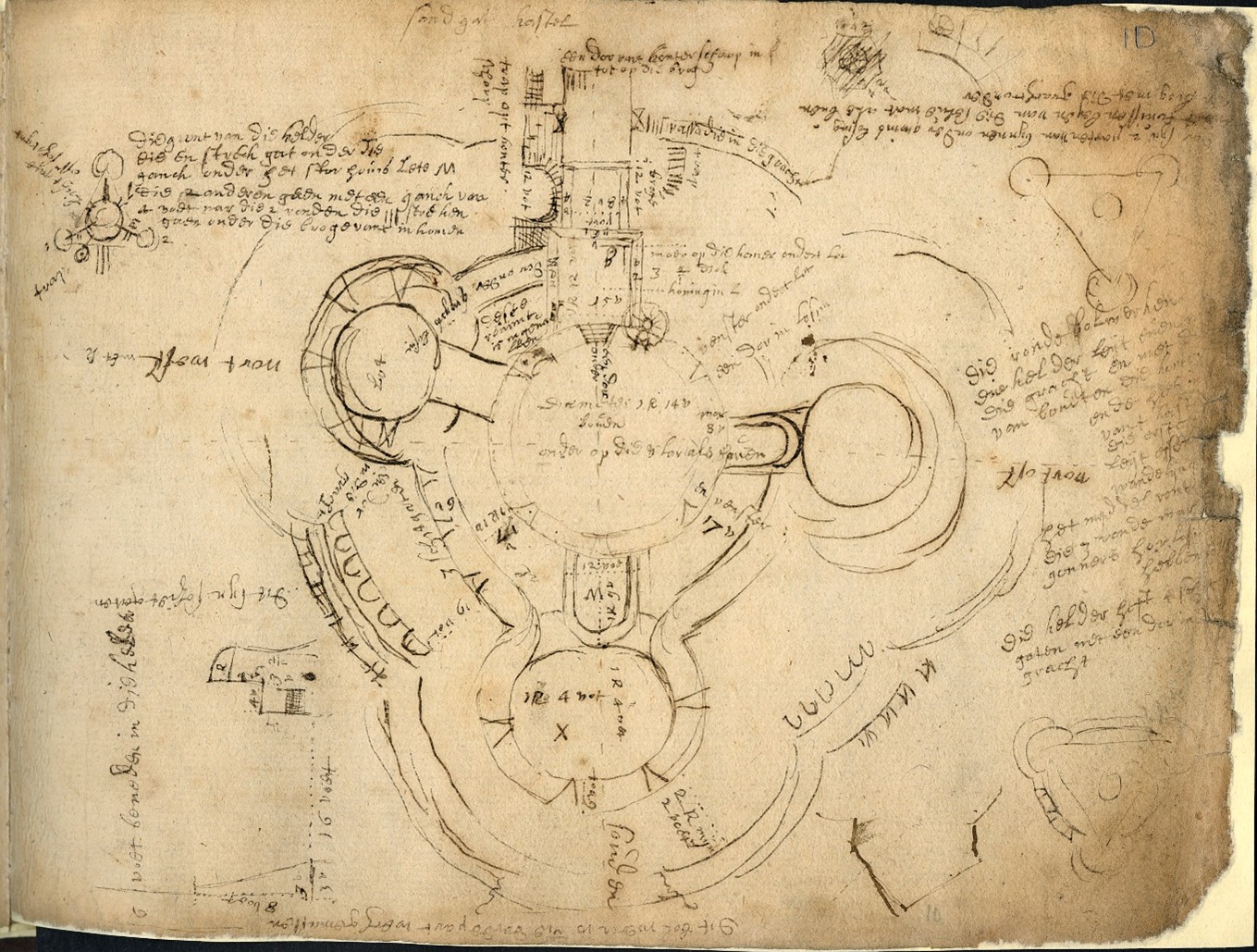
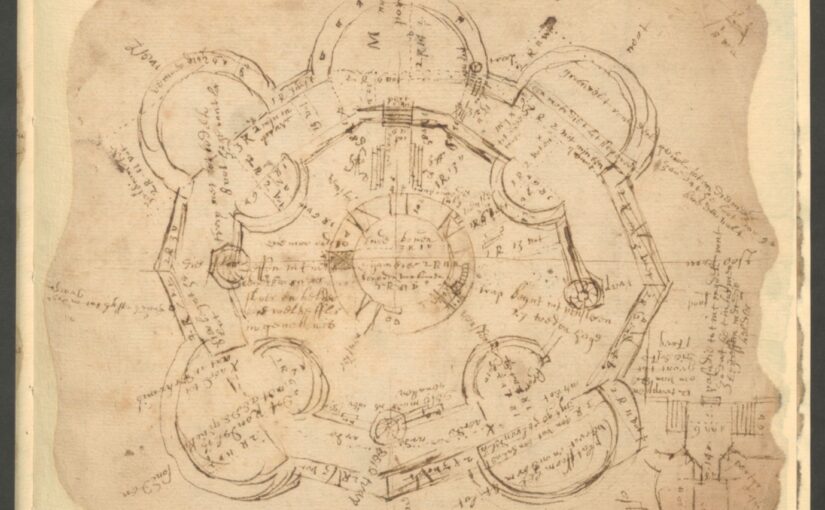
Plan of Sandgate from one of the folios of the document. Courtesy of Paul Pattison

Even though our unknown Dutch engineer was clearly in a hurry with his survey, as we reported last time, his work is accurate. For most sites there is usually a main plan taking up one face of a folio – a detailed and well-proportioned sketch with copious annotations that include measurements and notes on features of interest, sometimes including room use, and often pointing out defects requiring attention. In rare cases a room is named, notably ‘The Queen’s Room’ at Sandgate, a lovely, early reference to a tradition recording Elizabeth I’s stay at the castle in 1572. Sometimes, room functions are specified e.g. the porter’s lodge at Camber, giving valuable insight to the daily workings of a castle.

As well as a main drawing, the engineer also made smaller sketch plans and elevations to show details e.g. an elevation of the cupola at the centre of the roof at Deal Castle, noting also its use as both a gunpowder store and a sea mark; or a plan of a double-splayed gun embrasure at Walmer Castle. Typically, the particulars of each site are further noted in a separate block of text taking up another side of a folio, sometimes also incorporating small sketches. This text tends to summarise defects and requirements, so does not provide a full picture of the castle, but rather concentrates on repairs needed and remedies.

However, there is one atypical folio that mentions two known individuals. One is the relatively well-known master gunner at Dover Castle, William Eldred, notable for his authorship of The Gunners Glasse, a treatise on gunnery published in 1646. The other was a Mr Griffiths, secretary to Edward, Lord Zouche, who was Lord Warden of the Cinque Ports between 1615 and 1625. We are presently exploring them both in the State Papers at the National Archives and in other documents at the British Library and we are confident – and excited – that we will be able to tie down the date of the survey to the year.

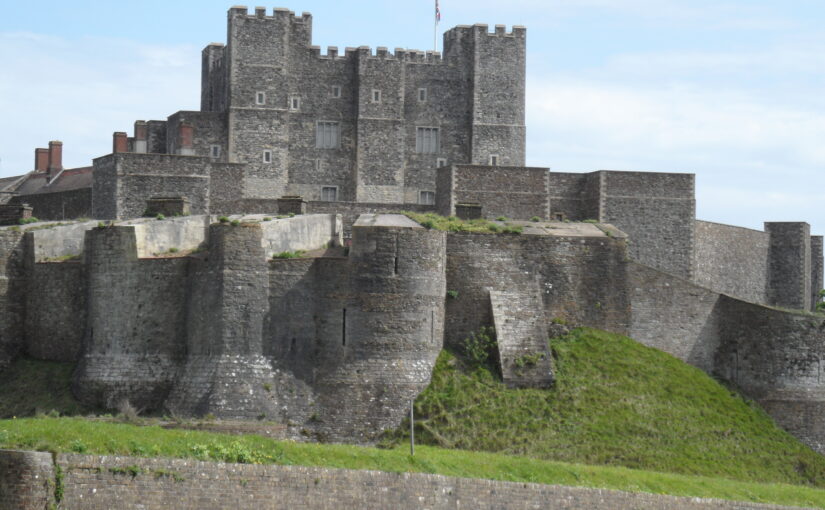
The translation of three other folios for Dover Castle represents a real step forward in understanding that castle during this otherwise hazy period in its history. The manuscript names and provides details of eight mural towers, two gates and three other buildings explored by the engineer, most of which we can relate to those surviving today, possibly the earliest evidence we have for named towers in the castle: a few of the names are previously unknown. There are three sketches of tower plans, which should enable their identification: one is certainly Fitzwilliam Gate. Many of the Dover Castle towers needed significant repairs, for which the engineer estimated costs. The Dover folios also record two forts defending the harbour and anchorage. The first is Moats Bulwark, the battery at the base of the cliff below the castle, just above the beach, and the small angle-bastioned fort guarding the western harbour, Archcliffe Fort.

Only recently, we have begun to look closely at another survey, long thought to be broadly contemporary, carried out in 1623 by the Board of Ordnance at the request of James I and his Privy Council. Our initial work on this, comparing entries for the same sites, suggests that the two surveys may be closely related and we look forward to providing another update here, when we have fully explored that intriguing possibility.
Subscribe to our quarterly newsletter

A large and varied crop of fascinating applications asking for a record amount of over £170,000 for the Castle Studies Trust to consider

The deadline for grant applications passed on 1 December. We’re going through the various projects now. Altogether the 21 projects (the most we have received since 2014), coming from all over the UK and Ireland, are asking for a record amount of over £170,000. They cover not only a wide period of history but also a broad range of topics.

Subscribe to our quarterly newsletter

In a little more detail, here are the applications we’ve received:

Bodiam, West Sussex: Co-funding the third season of the excavations of the Bodiam 100 project at the fourteenth century castle with the aim of understanding more about the castle in its broader landscape and chronology. The request is to fund post-excavation costs, scientific dating and assessment of samples and the costs of a weekend event focusing on pilgrim badges to highlight the discovery and significance of the late 14th century badge found in the castle moat during investigations in the 1970s

Buittle, Dumfries & Galloway: Co-fund a geophysical survey of the motte of the castle. This site, once the home of two Scottish kings and closely associated with some of the leading figures and events in the Scotland of the 13th and 14th centuries, may be one of the earliest Mottes with a stone structure.

Cainhoe, Bedfordshire: Geophysical survey of the remaining part of the site not covered in 2022, which focused on the fortified manor section. The survey will look at the earlier motte and bailey castle which seems to have been abandoned by the late thirteenth century.

Carew, Pembrokeshire: To create new interpretive materials for Carew Castle that translate existing historical, architectural and archaeological research into accessible easy read signage.

Cockermouth, Cumbria: Cockermouth Castle is an extensively surviving major multi-phase northern fortress whose evolutionary history has never been subject to systematic or formal assessment.  The proposed project will focus upon developing a detailed understanding of the physical fabric of the castle’s inner ward structures with a view to mapping their evolution, and to provide contextualization by relating the major building periods to the site’s known history and occupancy, and in terms of the broader evolution of castle architecture.

Dunster, Somerset: Photogrammetry survey and analysis of the castle to understand the different phasing of the castle which dates to shortly after the Norman Conquest and has been much altered since.

Subscribe to our quarterly newsletter

Durham Castle, County Durham: Investigating the Twelfth-Century Entranceway of Durham Castle. The aim of the project is to utilise digital archaeological techniques to create high-resolution images and models of the twelfth-century archway into Durham Castle’s North Range, enabling detailed investigation of the architectural features.

Ellesmere, Shropshire: Geophysical survey of the large motte and bailey castle in Shropshire which, prior to June 2024, had never been surveyed before when the large motte was surveyed by GPR which revealed possible buildings. The resistivity and magnetometry surveys would confirm that, as well as survey the rest of the site which played an active part in the Marcher disputes in the reign of Henry III.

Fyvie, Aberdeenshire: The project aims to create new interpretation drawings to showcase key stages in the architectural development of the castle, which dates to the thirteenth century, and share these as part of outreach and engagement.

Lesser-known Essex Castles: The project aims to process and interpret LIDAR data relating to 23 less well-known Essex Castle sites such as at Chipping Ongar and Canfield. These castles were selected from the data within the Essex Historic Environment Record (EHER) as having very little, if any, previous archaeological investigation.

Little Beblowe, Northumberland: Excavation of the remains of the Henrician fortification, the first purpose-built fortification on Lindesfarne. The fort was built in the 1540s and has never been excavated. With much of the fort already lost to coastal erosion, this is potentially one of the last opportunities to excavate the site and see if the various plans of the fort match what is there.

Pontefract, Yorkshire: Digital reconstruction of the gatehouse of this one-time royal castle based on the 2019 excavations and previous studies showing its original structure and later adaptations.

Poulton Hall, The Wirral: A geophysical survey around the current hall to see if there are any indications of a possible castle. There have been numerous finds by metal detectorists indicating a medieval past for the area and historical sources indicate the site was high status  throughout the middle ages.

Subscribe to our quarterly newsletter

Newcastle, Northumberland: To co-fund the publication of the report of the excavations of Newcastle Castle, one of the major royal castles in the North East of England, which took place over 20 years between 1974-95. The funds will be for synthesising all the different excavations, updating specialist reports and preparing relevant plans and illustrations.

Ruthin, Denbighshire: Co-funding a structural survey and analysis of the great gatehouse of this formidable thirteenth century baronial castle that was a key part of Edward I’s strategy to secure the conquest of Wales.

Sauchie Tower, Clackmannanshire: Co-fund the first ever full structural survey of this early fifteenth century tower built by Sir James Schaew [check spelling]. Exceptional among the four surviving mediaeval towers in the county for having had very little alteration, thus preserving its structural integrity.
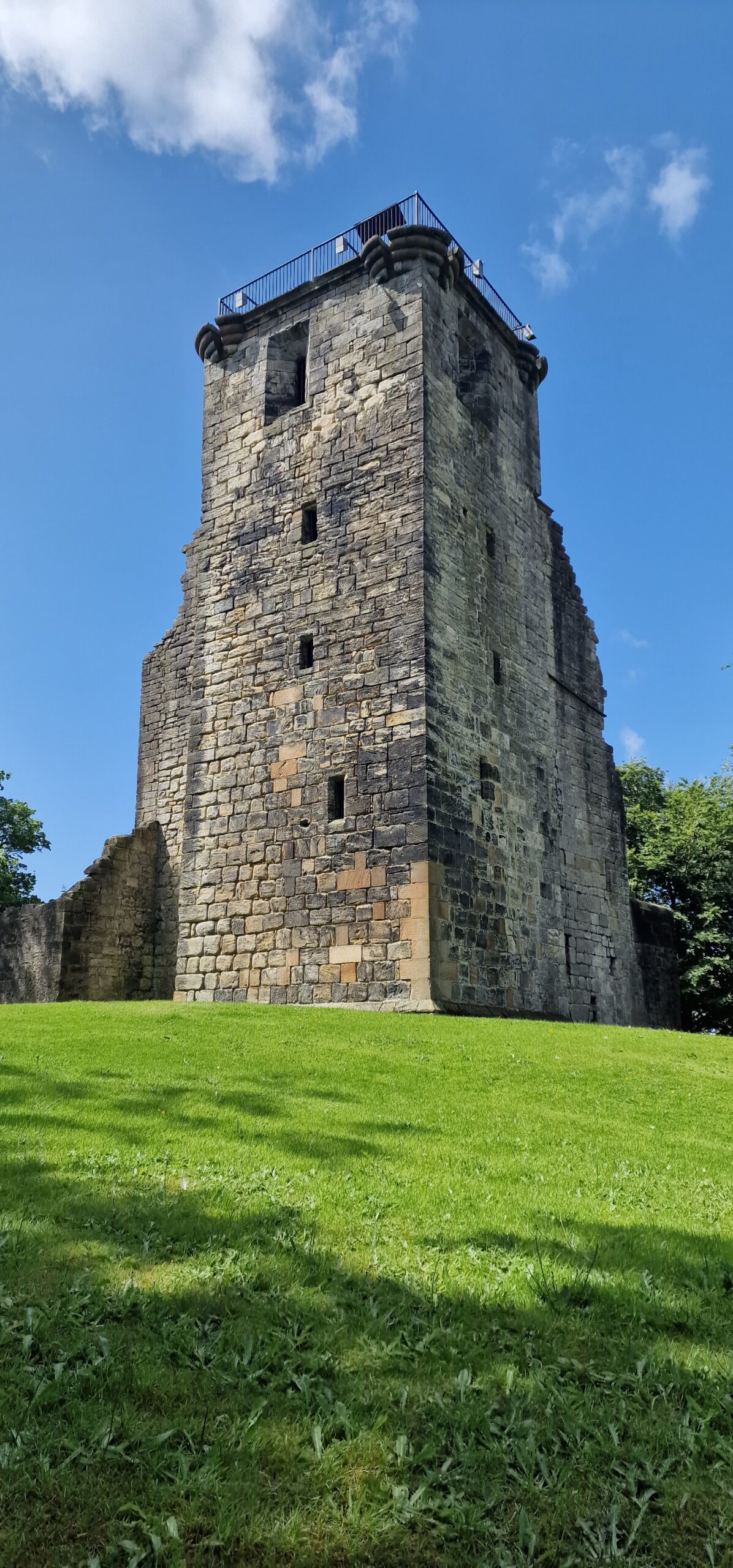
Sudeley Castle, Gloucestershire: Dating (via tree-ring dating) and recording with 3D imaging the original roofs of Sudeley Castles Outer Courtyard Ranges. The castle site dates to the anarchy but the castle was rebuilt in the fifteenth century by Lord Sudeley.

Temple House, Co. Sligo, Ireland : To co-fund the geophysical and LiDAR surveys of the site of this castle which was a preceptory (administrative centre) for the Knights Templar in Ireland. Historians have long recognized Templehouse as an example of the far-reaching influence of the Knights Templar in Western Europe. However, no scholarly research and no extensive archaeological work has been published on the site, besides a 2016 topographical survey

Tor, Highlands: Co-fund a LiDAR survey to try to locate earlier structures than the current remains of a C16 tower house. The site is thought to date to the early medieval period and was mentioned as the major site of Banquo of Macbeth fame.

Walton, Suffolk: Marine geophysical survey of the castle which collapsed into the North Sea in the eighteenth century. Originally a Roman Saxon Shore fort, it was later converted into a Norman castle by one of the Bigod earls and then destroyed by Henry II after the 1173-4 rebellion.

Subscribe to our quarterly newsletter

The applications have been sent to our assessors who will review them. You can see how the assessment process works from our blog back in January 2016: https://castlestudiestrust.org/blog/2016/01/17/how-the-castle-studies-trust-selects-its-projects/

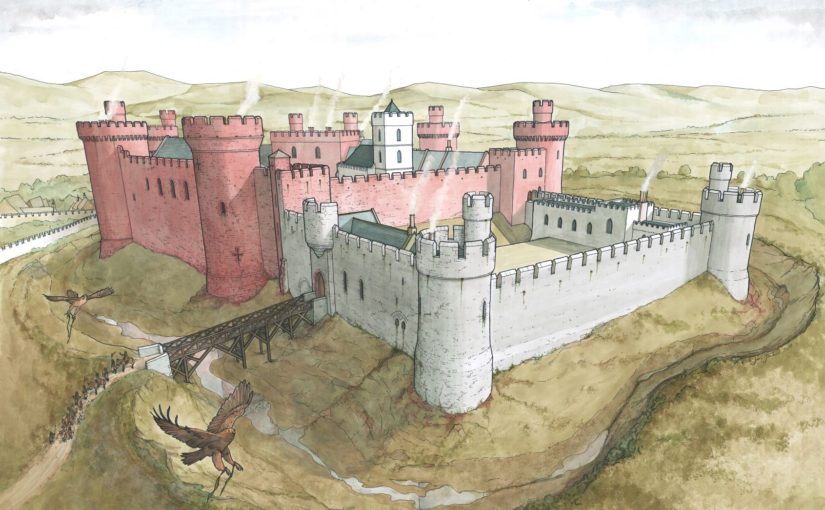
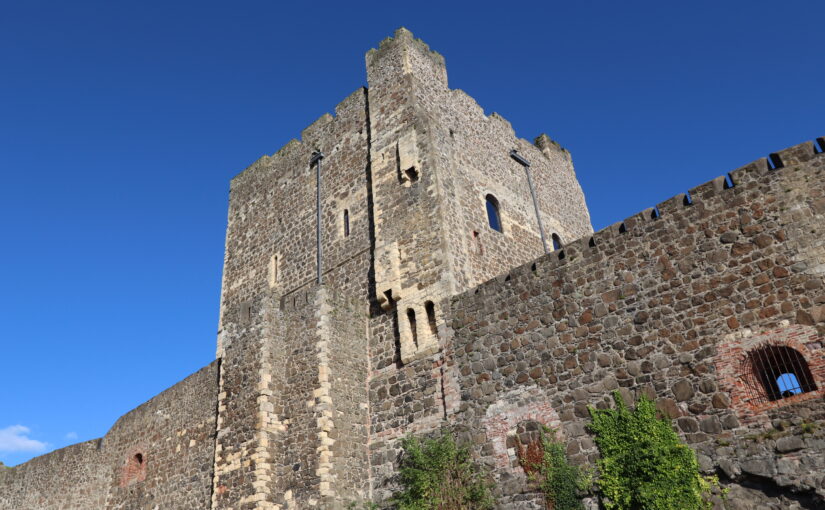
Featured image is of a reconstruction drawing of Ruthin Castle by Chris Jones-Jenkins which we co-funded previously. This does not indicate any particular preference for any project.

Carrickfergus: the castle as an agent for change

In the second of two articles, Dr Christian Clarkson, Heritage Consultant at Simpson Brown takes a look at the work she undertook at Carrickfergus Castle.

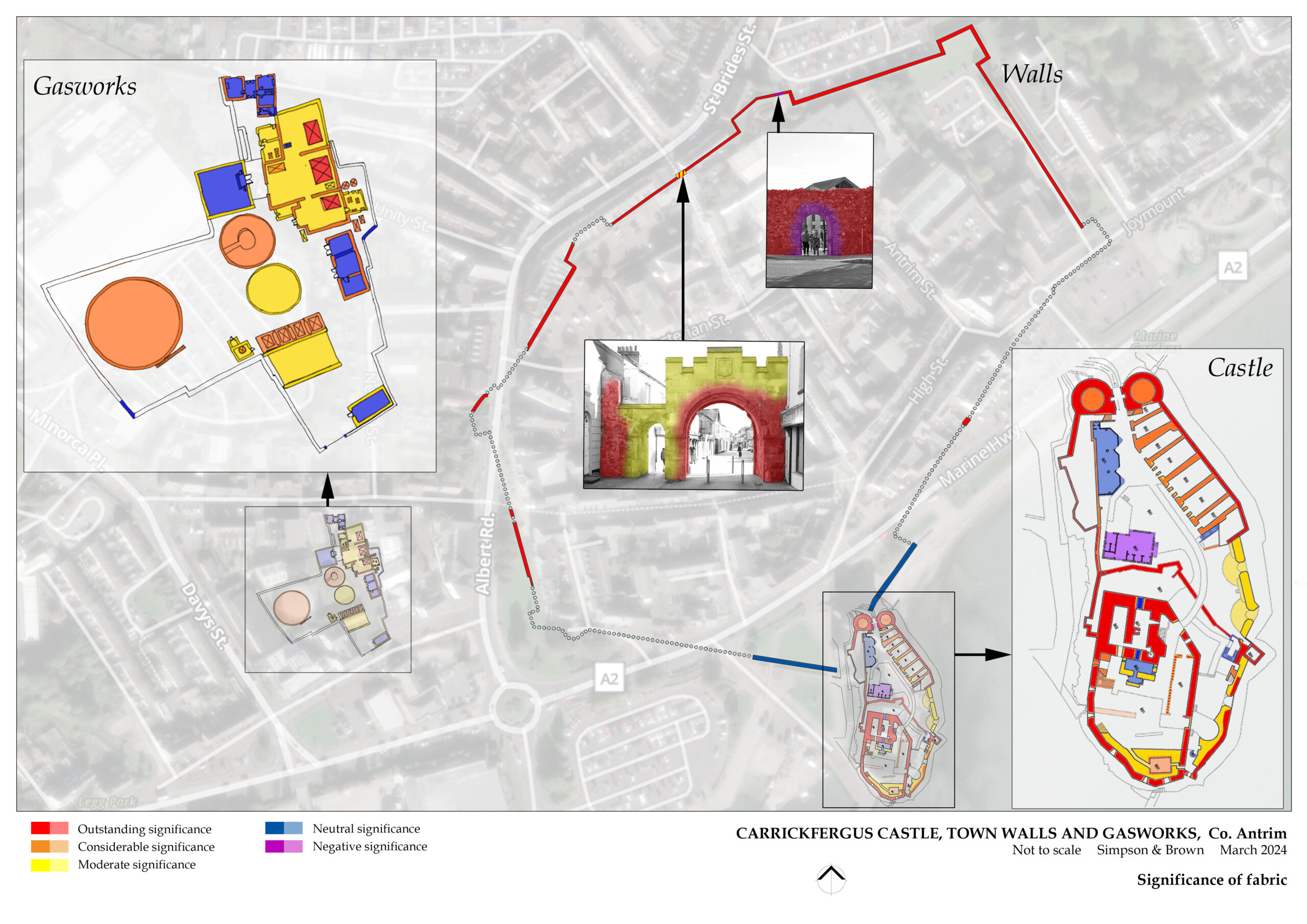
In 2023, Simpson & Brown were engaged as heritage consultants to write conservation plans for three historic structures in Carrickfergus, Co. Antrim: the Elizabethan town walls; the Category A-listed historic gasworks museum; and Carrickfergus Castle. Situated dramatically on the coast of Belfast Lough, Carrickfergus Castle dominates the town and is one of the most impressive castles on the island of Ireland. Simpson & Brown’s work was part of the Carrickfergus City Deal, an investment programme which seeks to put heritage at the heart of a regeneration of the town.

Subscribe to our quarterly newsletter

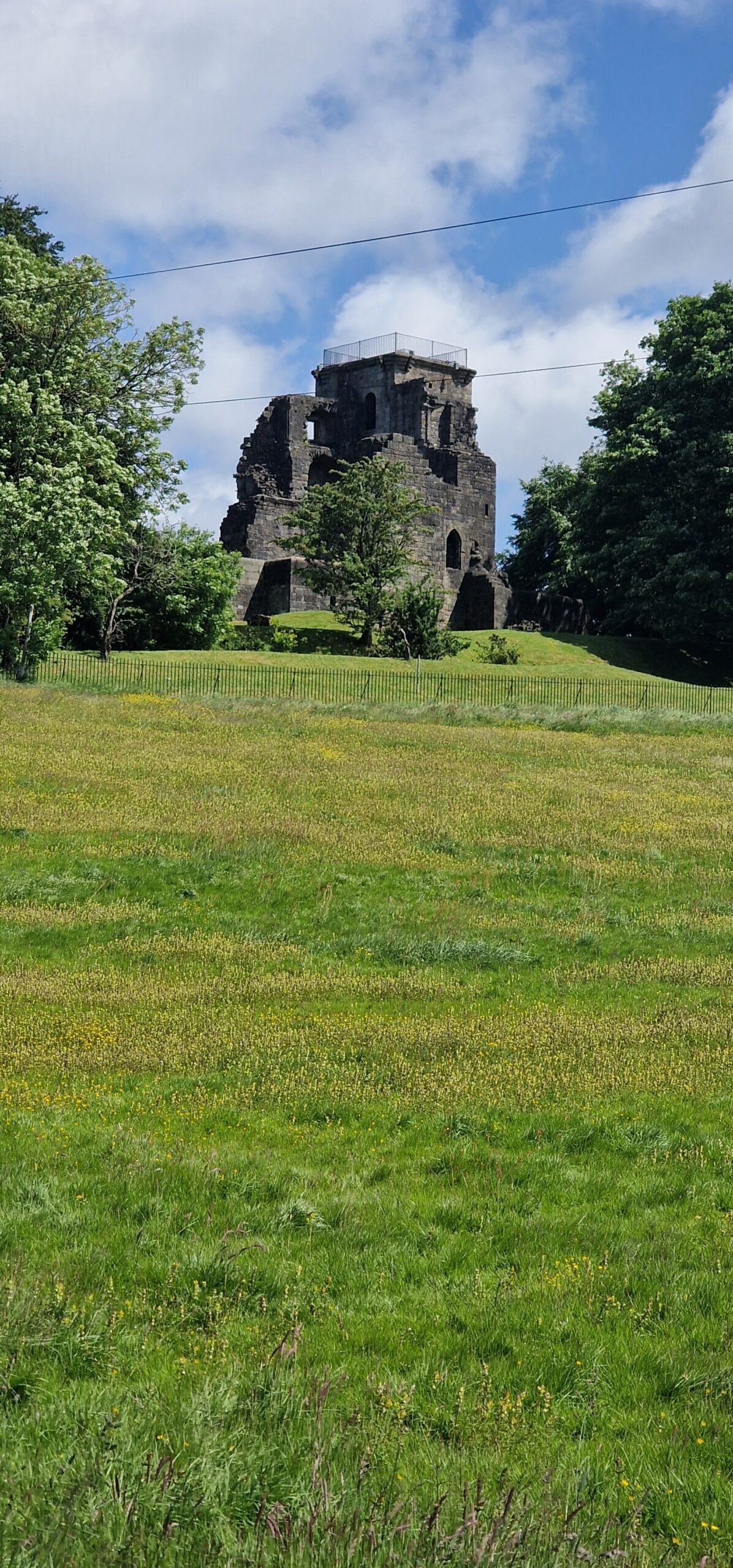
Carrickfergus and the three sites being analysed by Simpson Brown, copyright Simpson Brown

This programme brought into sharp focus the key concern of our work as heritage consultants: managing change. Some degree of change would be needed at the castle to achieve the aims of the deal, and this change would have to be executed with as little negative impact as possible on the qualities which make Carrickfergus Castle special, its cultural-heritage significance. Our job as heritage consultants was to express that significance, and consider how the proposals of the City Deal might impact it.

Our work had to be based on a solid understanding of the history of the castle, and in the case of Carrickfergus we were lucky enough to have decades of quality scholarship at our fingertips with regards to its medieval fabric, in particular in the work of Tom McNeill and Ruairí Ó Baoill (for example, the former’s work with Sarah Gormley as published in CSG Journal 30, 2016-17). Naturally, however, all medieval fabric at the castle would be significant to a very high level: more complex, in some ways, was considering the degree to which, and the ways in which, later fabric at Carrickfergus is significant.

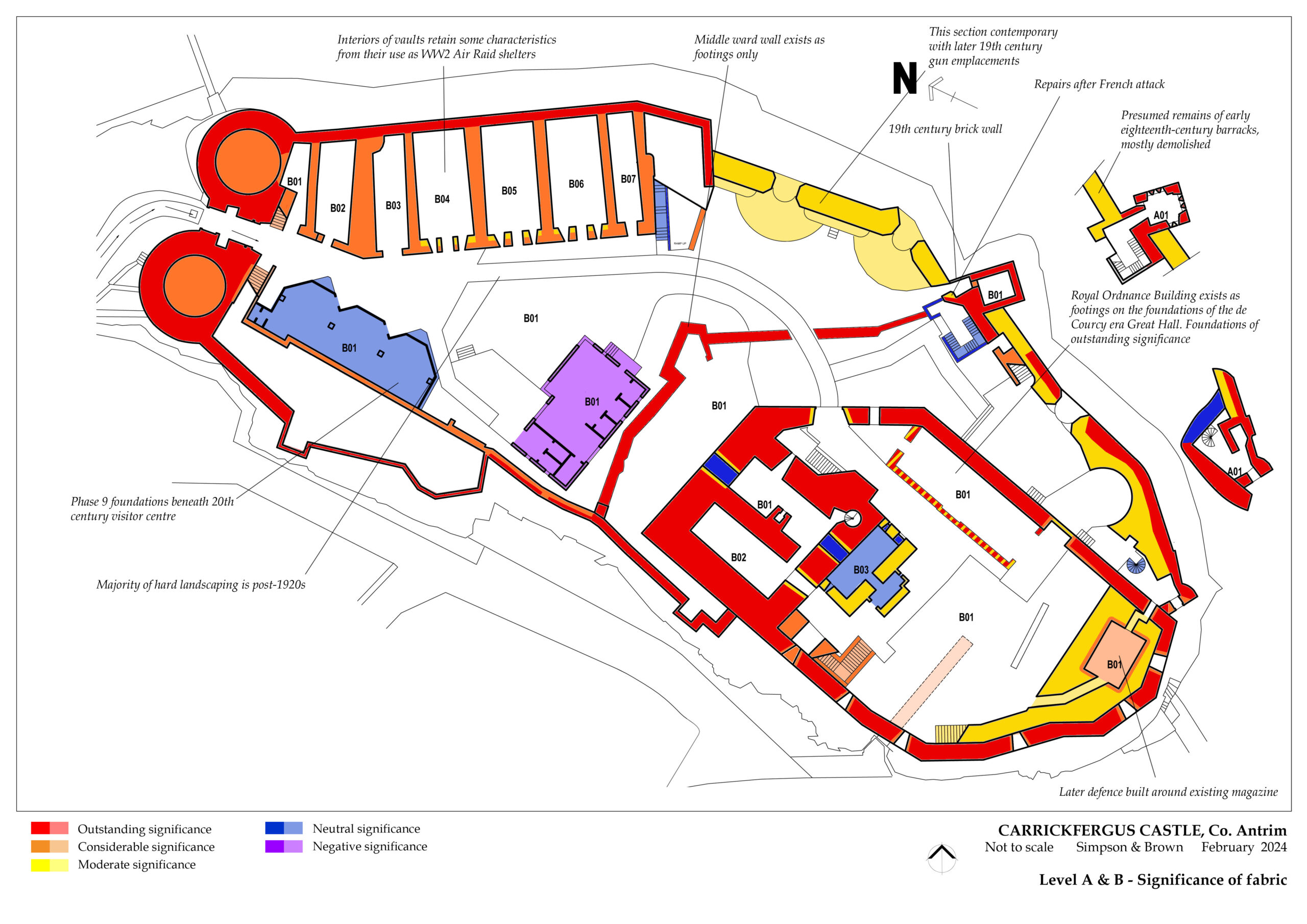
Plan of Carrickfergus Castle annotated to show archaeological significance of the remains, copyright Simpson Brown

Although there is evidence of prehistoric activity on the same site, the history of the castle itself begins in the late twelfth century when it was founded by John de Courcy shortly after his 1177 invasion of Ulster; much of what is now the Great Tower and inner ward was constructed at this time. The middle ward wall was built by King John in the early thirteenth century, and the outer ward and gatehouse by Hugh de Lacy, probably around the 1230s. While the castle had grown effectively to its full extent by the middle of the thirteenth century, its military and architectural life was only just beginning. Extensive work was carried out in the later sixteenth century to equip the building to withstand and return the heavier artillery fire of the period. In the seventeenth and eighteenth centuries it was used as a prison and as a garrison, and in the late eighteenth and early nineteenth century its defences were significantly upgraded including the construction of the Grand Battery on top of the sixteenth-century vaults. In the later nineteenth century, a small railway was built to bring supplies up and through the inner ward wall from the adjacent pier, and we found that it was likely that changes to fortifications at this time had been greater than previously thought: our fabric analysis showed that it was likely that masonry on the north wall was contemporary with neighbouring gun emplacements, meaning that this areas was more comprehensively rebuilt at this time. The castle even remained in service through the first and second world wars, providing military defence in the former and civilian air raid shelters in the latter. In the later twentieth and twenty-first centuries, the site has seen some fabric changes including the construction of the 1990s visitor centre, and the exceptional new roof of the Great Tower, mentioned in CSG Journal 35 (2021-22).

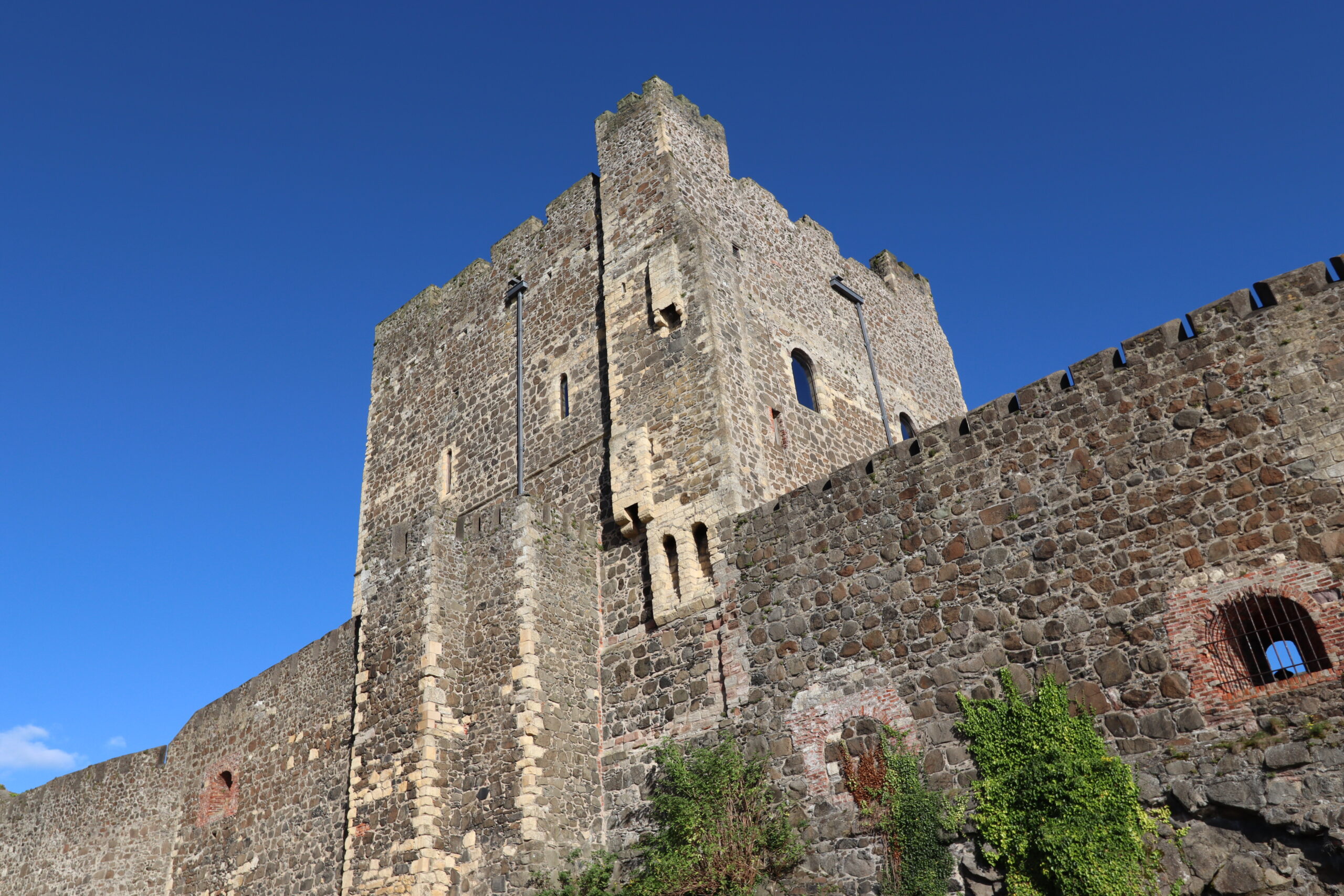
Carrickfergus Keep, copyright Simpson Brown

While our archaeology team reviewed all documented archaeological work on the castle site, the heritage consultancy division worked on adding as much as possible to our knowledge of the later life of the castle, including hunting archival photographs and documents at the Public Record Office in Belfast, PRONI. Nineteenth-century photographs revealed the form of buildings and structures which have since been lost, such as the Royal Ordnance Building on the site of the original great hall in the inner ward, and nineteenth-century garrison buildings where the visitor centre currently stands. The visitor centre had been constructed without a programme of archaeological work, and there was potential for change in this part of the site as part of the City Deal: one proposal considered removing the castle visitor centre to replace it with a multi-site visitor centre outside the castle itself. Knowing what stood on this site prior to the existing visitor centre informed potential future archaeology in this area. The removal of the visitor centre could be a potential improvement to the site: while the existing building solves the problem of accommodating a shop and ticket office reasonably well, a clear view towards the keep from the gatehouse would be preferable in terms of recreating the historic experience of arriving in the outer ward.

The Royal Ordnance Building appears as a gable-end in historic photographs, constructed of rubble with brick window surrounds, and a footprint approximately that of the medieval hall. The City Deal considered the possibility of constructing visitor facilities on this footprint: knowing some details of the size and appearance of the Ordnance Building could inform what a new building here might look like, although we felt that it might be challenging to accommodate plant, for example, in a space as sensitive as the inner ward.

Ultimately, our analysis suggested that while the highest level of significance should be ascribed to the medieval fabric, there was still significance at the site derived from its later military architecture, including for example the WW1 gun emplacements. We did find a negative effect on heritage values from some contemporary changes at the castle, and recommended that the important functions that those changes served be accommodated in a way which better complemented the fabric. These included the existing stairs and events space, as well as the temporary education building straddling the footings of the middle ward wall: our assessment can act as a starting-point for discussion of change in these areas. Where we consider how to protect and enhance heritage significance, this can come into conflict with requirements for, for example, sustainability or accessibility: our documents are designed to equip our clients with the heritage knowledge they need to weight this against these other important needs, to generate the best possible outcomes both for the building, but also the community.
Subscribe to our quarterly newsletter

Update from Visualising Canterbury Castle: the importance of the site visit

Project lead of the Canterbury Castle Visualisation project, Dr Katie McGown, gives an update on how the project is progressing.

The Visualising Canterbury Castle project is in the process of producing a new digital reconstruction of Canterbury Castle’s Norman keep. In our last post we discussed the first of a series of co-design sessions we have organised to allow a range of expertise and stakeholders to help us develop and interrogate the model we are producing. However, this is not the only way we are collating information to inform our understanding of the built structure.

Subscribe to our quarterly newsletter

Canterbury Castle has been closed to the public since 2018, and as it is currently being refurbished, the walls are obscured by scaffolding. Because of this, initially we drew heavily on Excavations at Canterbury Castle (Bennet et al, 1982) published by CAT, which features elevation and plan drawings. This helped us map out the size and shape of the building for the early stages of the model. However, over the course of the development of the project, questions have arisen about areas of the building which are no longer extant, and we’ve had to piece together information from other sources, and crucially, by visiting other castles. 

After the first co-design session our student interns, Ethan Serfontein and Joseph Seare, and Technical Lead, Mike Farrant, were invited to Rochester Castle by Dr Jeremy Ashbee, Head Properties Curator, English Heritage. Through visiting a similar structure, the team gained greater understanding of both the defining features of a Norman keep, and how we can draw evidence from the building to inform our reconstruction.

Joseph (l) and Ethan (r) from the project team visiting Rochester Castle (copyright Dr Katie McGown)

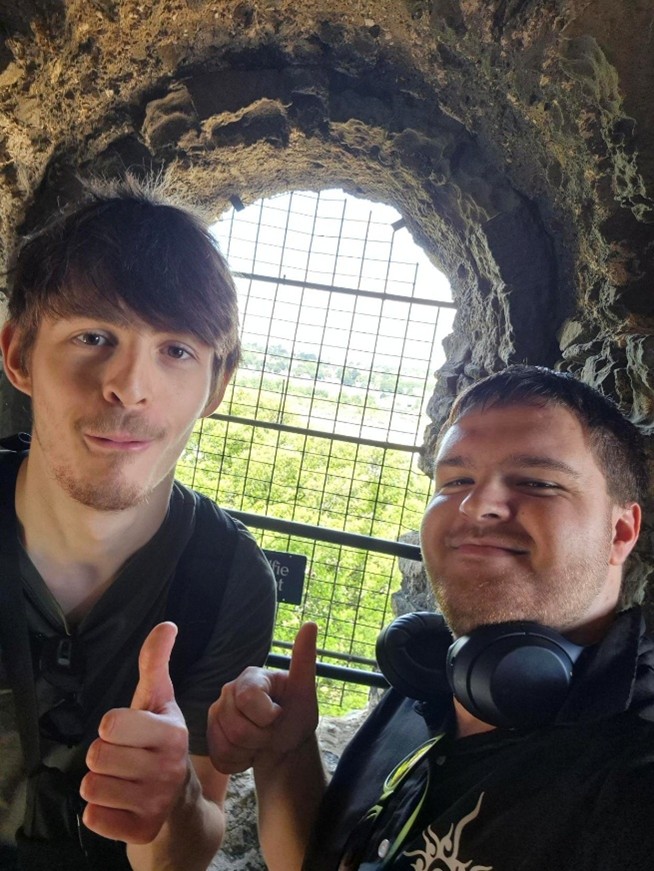
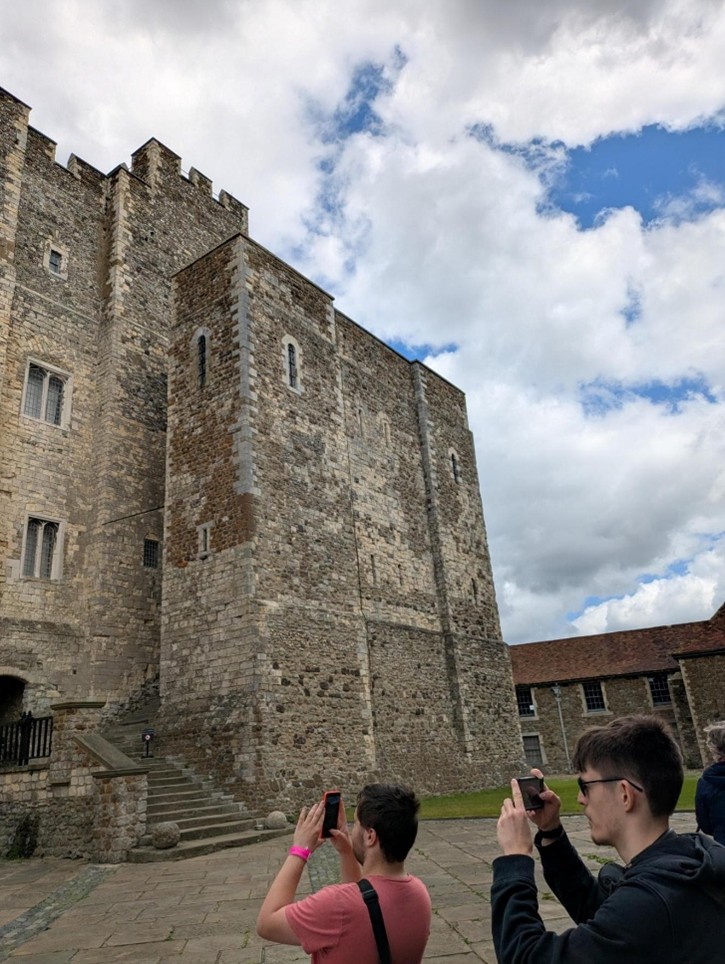
As we continued to develop the digital reconstruction, questions began to emerge about the structure of the outer staircase and how this would look. This is a difficult question to answer given that the structure no longer exists. However, the team were able to develop a better understanding of how the space might have worked by comparing their observations in Rochester with a visit to Dover Castle. Professor Alan Meades, Dr Cat Cooper, Mike, Joseph and Ethan went down to Dover and spent time discussing the differences between the three Royal Norman castles in Kent, and documenting features like the staircase. Dover Castle also gave the team the opportunity to appreciate the lovely Norman interiors.

Subscribe to our quarterly newsletter

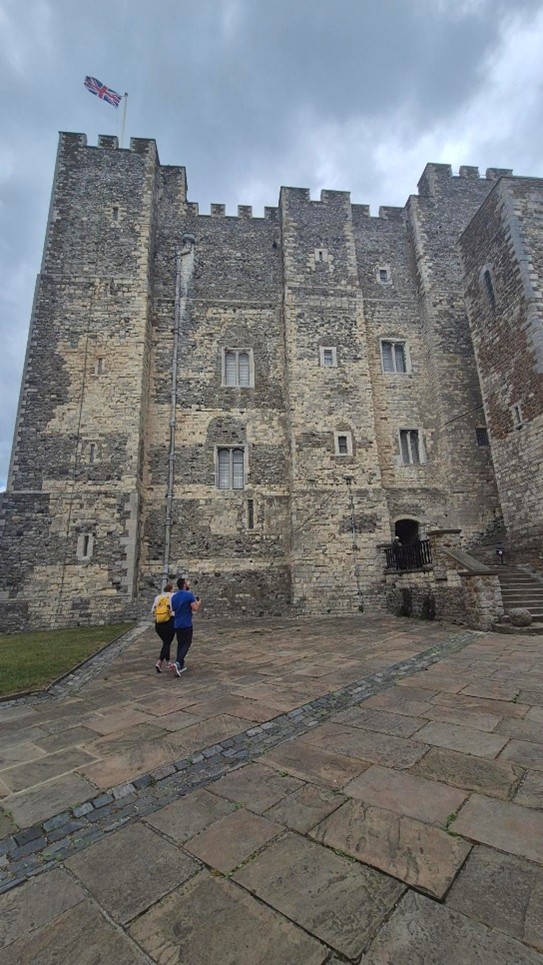
Dover Castle Keep copyright Dr Katie McGown
Christchurch, Canterbury visualising team visiting Dover Castle, copyright Dr Katie McGown

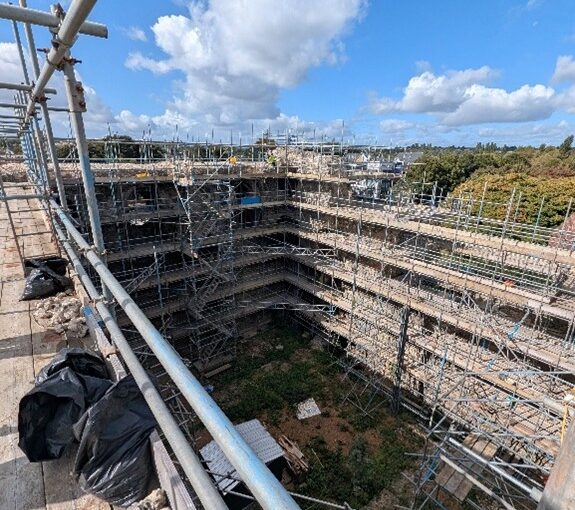
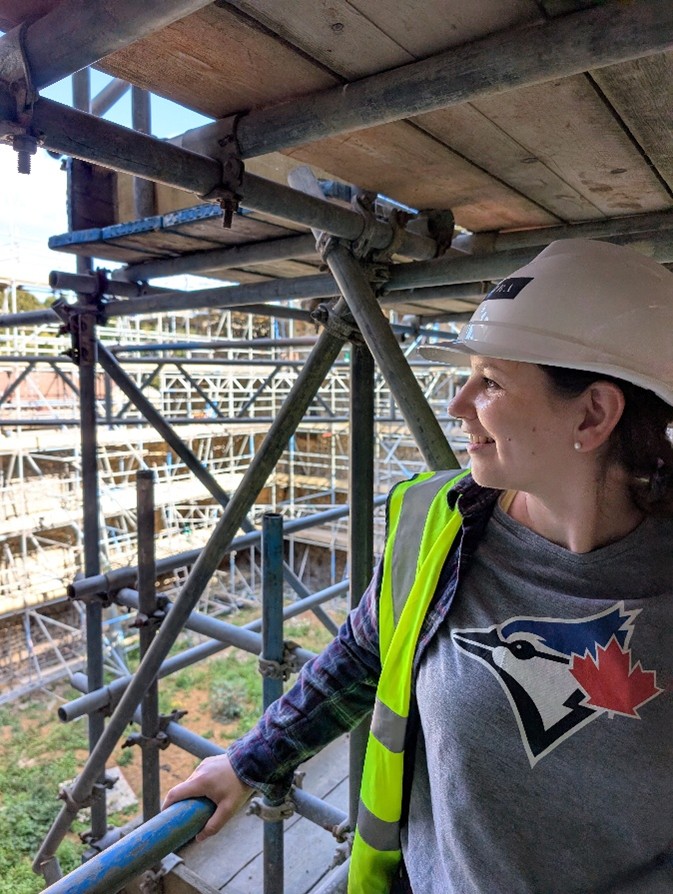
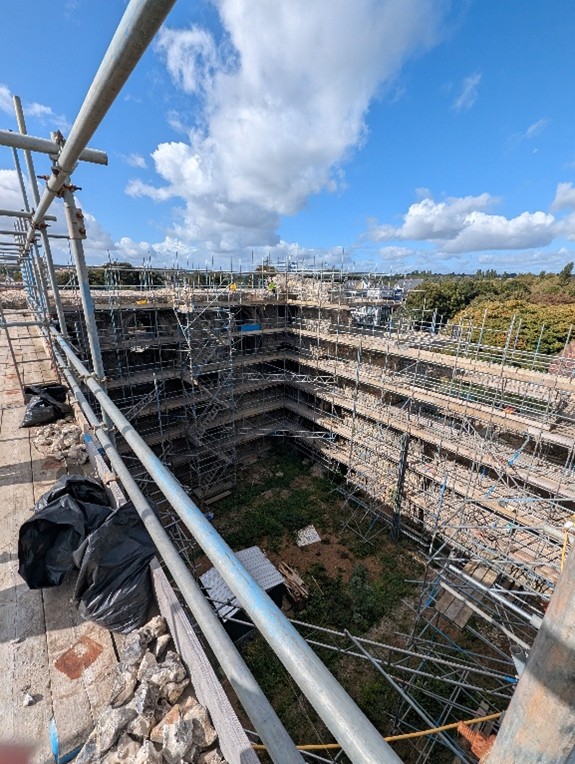
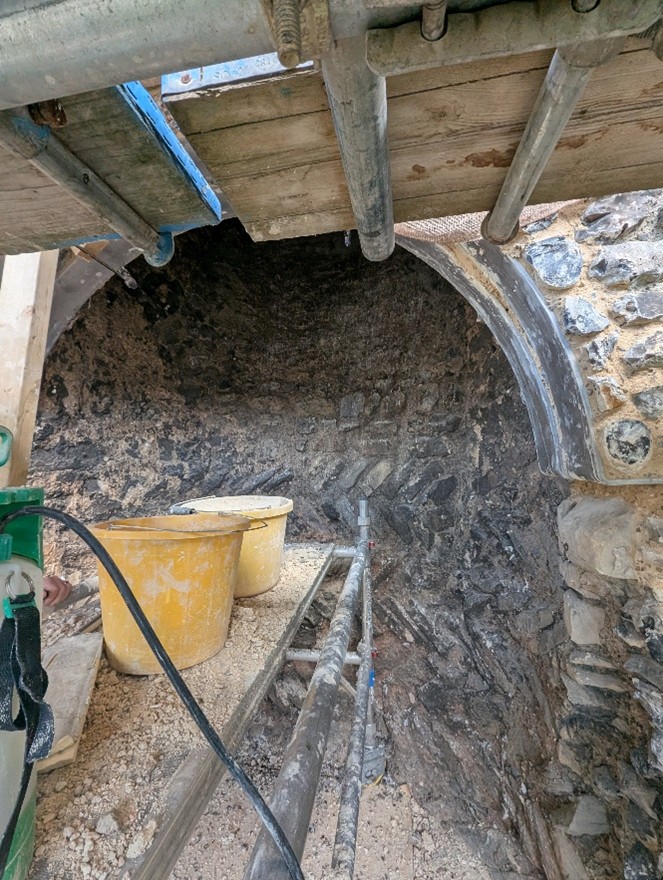
Recently, we were able to visit Canterbury Castle, courtesy of Lian Harter from Purcell and Alison Hargreaves from Canterbury City Council. Dr Katie McGown and Cat donned high vis, hard hats, and steelies to climb the scaffolding. This visit allowed them to think about sight lines around the city, but also observe important details such as this stunning herringbone brickwork in the fireplace. The tour also gave us incredible insight into the refurbishment of the keep, and how that process might be incorporated into the eventual curriculum resource that accompanies the project.

Dr Katie McGown visiting Canterbury Castle refurbishment
Canterbury Castle refurbishment copyright Dr Katie McGown
Herringbone fireplace at Canterbury Castle, copyright Dr Katie McGown

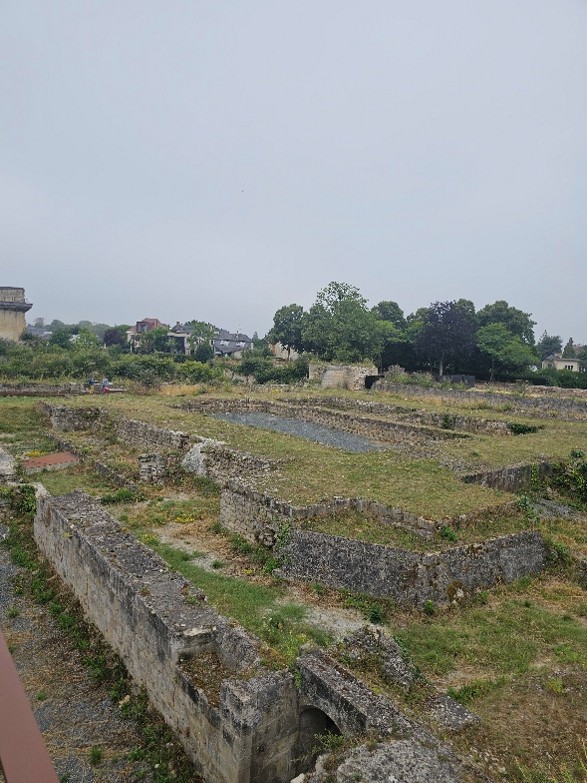
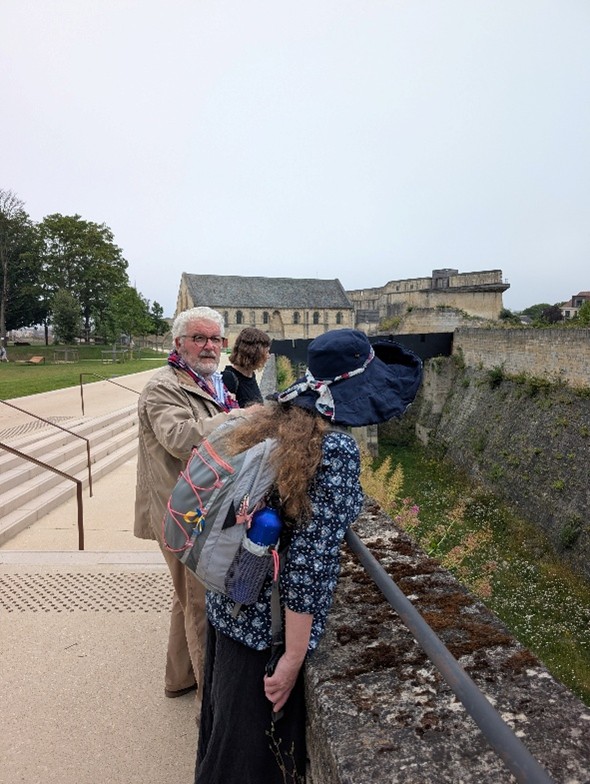
We’ve also been thinking more broadly about how the project might fit into wider activities in development for the 2027 European Year of the Normans. Professor Leonie Hicks, Cat and Katie travelled to Caen Castle to see about possible collaborations for work at the site, and were delighted to have a detailed tour led by Curator Jean-Marie Levesque around the delicate foundations of Caen Castle’s Norman keep. The team also took the opportunity to see the Bayeux Tapestry prior to its voyage to the British Museum.  

Caen Castle, copyright Dr Katie McGown
Canterbury Castle visualisation team with Caen Castle curator Jean-Marie Levesque

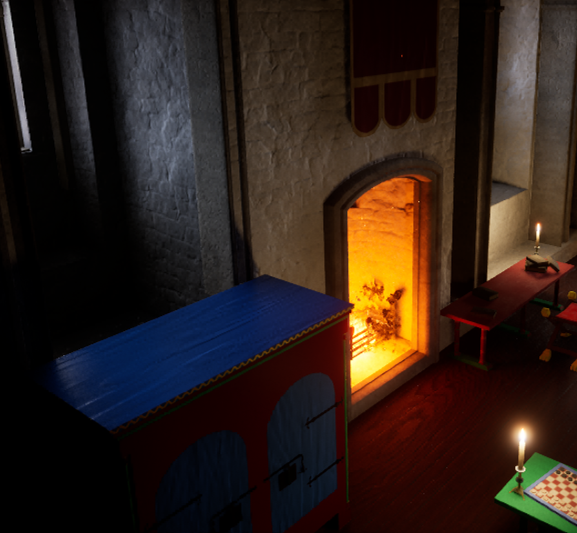
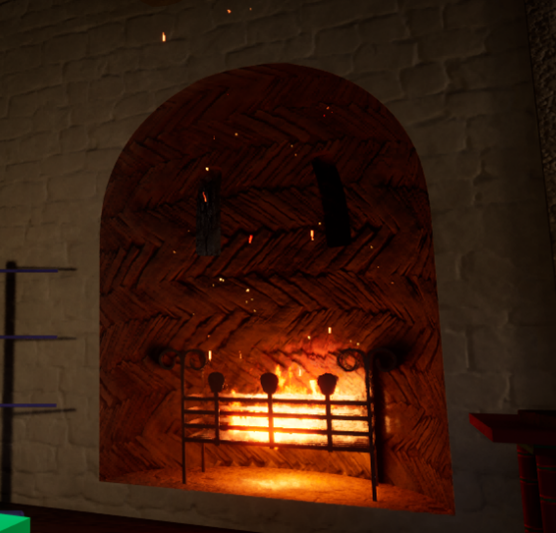
Each of these visits informs the development of the digital reconstruction. For example, following the visit to Canterbury Castle, the fireplaces were adjusted to showcase the herringbone brickwork.

Original visualisation of Canterbury Castle fireplace prior to visit. Copyright Canterbury Castle Visualisation
Canterbury Castle Visualisation updated fireplace with herringbone stonework. Copyright Christchurch Canterbury Visualisation

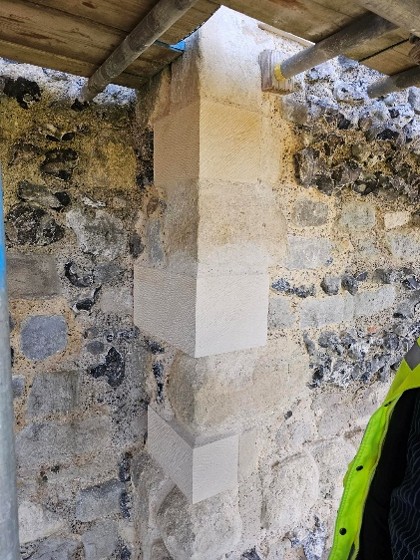
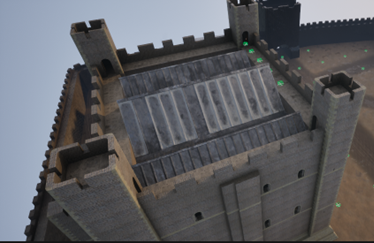
Similarly, being able to see the refurbishment of Canterbury’s Caen stone has informed the exterior of the digital reconstruction.

Refurbishment of Canterbury Castle with new Caen stone, copyright Dr Katie McGown
Canterbury Castle Visualisation updated to include Caen stone noted in the castle restoration, copyright Christchurch Canterbury Visualisation team

The team has one final visit planned to Norwich Castle before the end of the project, and we are looking forward to continuing to develop our understanding and appreciation of Norman keeps.   

Subscribe to our quarterly newsletter

Finlaggan, Islay: a lost royal castle without a name

Dr David Caldwell, formerly of the National Museum of Scotland, has just had the results of his excavations at Finlaggan in the 1990s published by the Society of Antiquaries of Scotland. Here he describes one of the more unexpected outcomes of the dig.

The main aim of the Finlaggan archaeological project was to shed light on a place believed to be the centre of the Lordship of the Isles in the fourteenth and fifteenth century. It consisted of two adjacent islands, Eilean Mór (the large island) and Eilean na Comhairle (the council island), in a freshwater loch in the island of Islay off the west coast of Scotland. The site was described as a castle by the Royal Commission in their inventory of ancient monuments published in 1984, but as the author pointed out to friends and colleagues on many occasions there was no such thing. Such documentary evidence as there was suggested an unfortified, palatial complex and that is what was discovered in the excavations, a residential and administrative centre for a large lordship spanning the Western Isles and parts of the mainland, a place where new lords were made and a council of the Isles met.
Subscribe to our quarterly newsletter

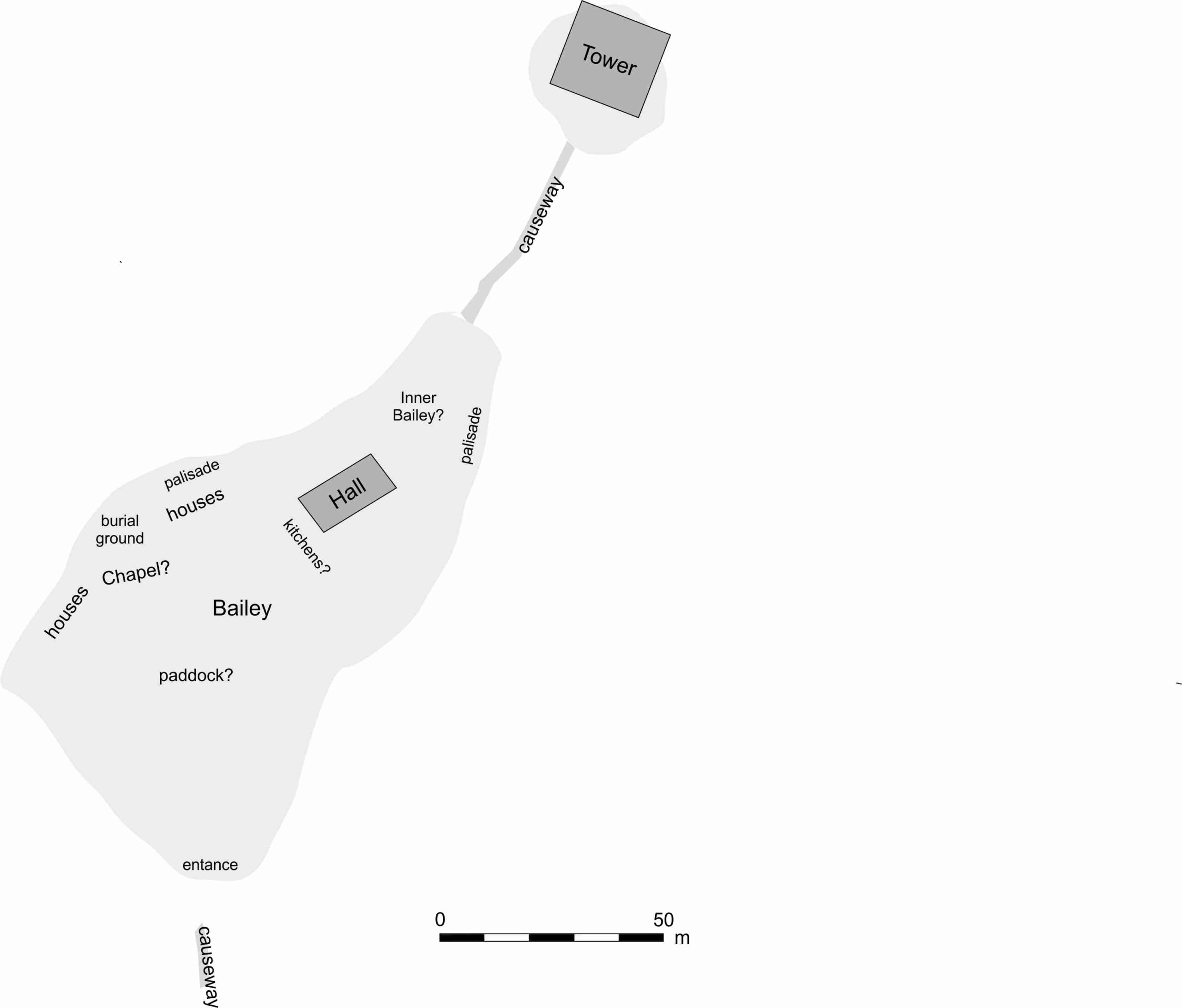
Plan of Finlaggan Castle, copyright David Caldwell

But the practice of archaeology is rarely straightforward and is always likely to produce evidence contrary to the predictions required for research proposals. So it turned out that the later medieval residence of the lords was a successor to a castle of twelfth-  and thirteenth-century date. There was a substantial, 19m square masonry tower occupying all the available space on Eilean na Comhairle, connected by a stone causeway to Eilean Mór. Only tantalisingly small glimpses of castle structures could be seen here under later structures, but enough to be clear that there was a timber palisade enclosing structures including a great hall, kitchens, houses and probably a chapel. Another stone causeway provided access from the lochside.

This was clearly a major castle but no records of its existence have been found in the admittedly meagre documentary records for this part of the world. We do not know for sure who might have had it built, nor do we have any certainty about what it might have been called. Eilean Mór was known in later medieval times as the island of St Finlaggan, referencing the cult of a saint, Findlugán, a contemporary of St Columba. It is possible that that dedication is no earlier than about 1300 and has resulted in the loss of an earlier placename of Scandinavian type. Most of the surrounding farm names are Gaelicisations of Norse names.

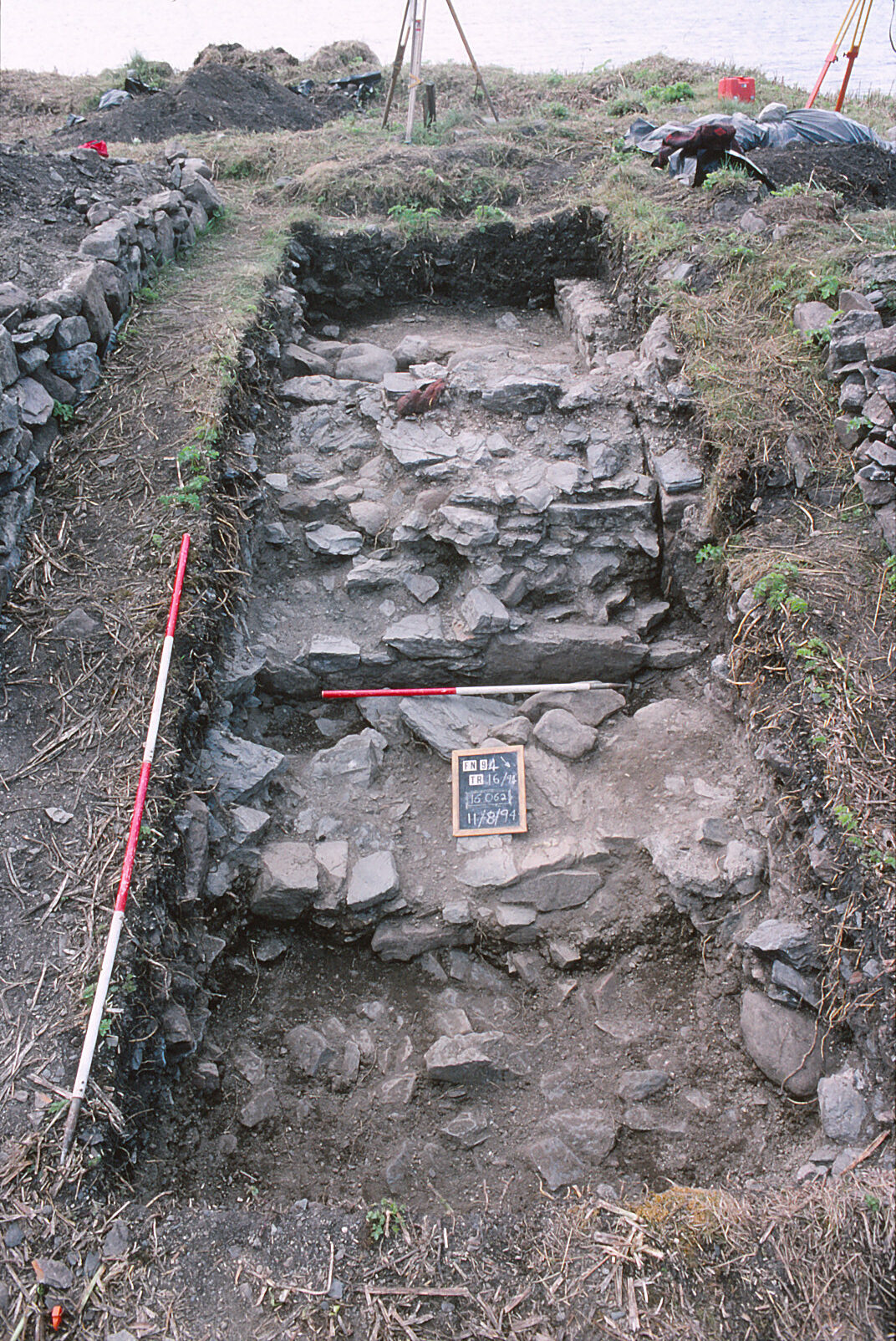
Finlaggan Castle excavation (1994): looking west  over  plinth  16062  and  castle  wall  16025B.  A  fragment of red sandstone marks the side of the much denuded castle entrance. Copyright David Caldwell

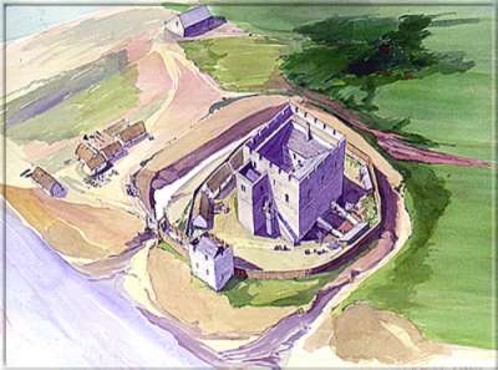
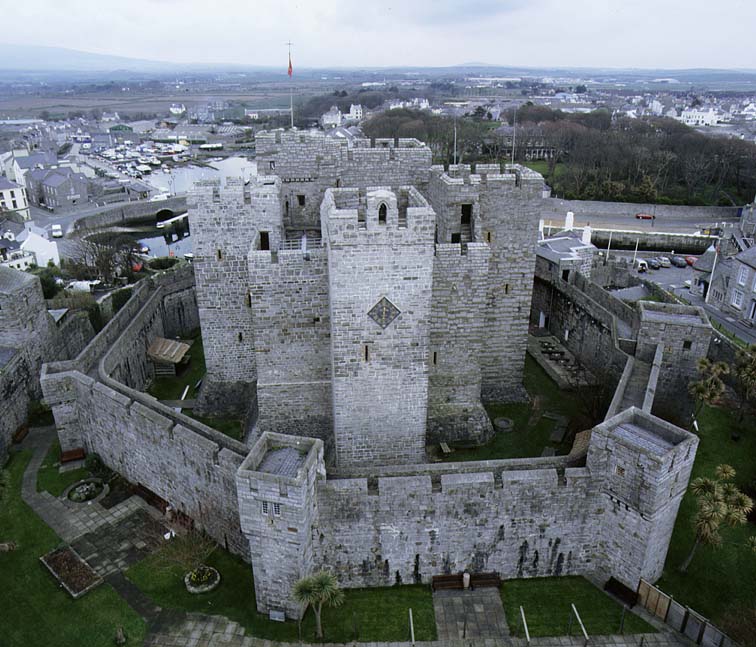
In terms of size the Finlaggan tower is similar to the one that forms the core of Castle Rushen, now believed to have been built for Rognvald Godredsson, King of the Isles from 1188 to 1226. The masonry, with coursed, long and low rubble blocks, is similar to Finlaggan. King Rognvald is clearly a contender to be considered the builder of the Finlaggan tower. The writer, however, believes that a more likely candidate for this role was Rognvald’s rival for power in the kingdom, Ranald son of Somerled, also regarded as a king. He was the ancestor of the MacDonalds and according to later traditions, a crusader. There are two main reasons for this identification.

Reconstruction drawing of the core of Castle Rushen when first built, Isle of Man, copyright Manx Heritage
Core of Castle Rushen today, copyright Manx Heritage

First, a substantial midden deposit in the loch adjacent to Eilean na Comhairle was sampled and produced ample evidence for fine dining by a lordly or kingly household in the thirteenth century and many sherds of medieval wheel-made pottery. There is no evidence of such ceramics being manufactured anywhere in the Isles apart from the Isle of Man and so all the wheel-made pottery recovered at Finlaggan can be regarded as imports, almost all from the Scottish mainland. No Manx pottery has been recovered from Finlaggan or other Hebridean sites and no Scottish medieval pottery has been recorded from the Isle of Man. Somerled and Ranald held lands in Scotland and their activities and rise to power can be seen in the context of a Scottish push westwards that resulted in the acquisition of all the kingdom of the Isles in 1266. The Chronicle of the Kings of Man and the Isles maintained at Rushen Abbey in Man maintained that the breakup of the Kingdom of the Isles into two parts was down to Somerled’s sons.

Second, it appears that Finlaggan was an important thing (assembly) site, arguably the predecessor of Tynwald in the Isle of Man. The actual place for meetings would have been on Eilean na Comhairle. The erection of a massive tower on top of it has the appearance of a hostile act by an incoming power. It is possible that the main Islay residence for the dynasty of kings based in the Isle of Man, ancestors of Rognvald Godredsson, was Dùn Ghùaidhre. The folk of Islay are clear that it is named for King Godred Crovan who died in Islay in 1095.

The Archaeology of Finlaggan, Islay is available from the Society of Antiquaries of Scotland’s online shop, with a 20% discount for Fellows of the Society. Dr Caldwell will also be delivering a free public lecture on Finlaggan on Saturday 29 November in Edinburgh and online.

Subscribe to our quarterly newsletter

Deciphering the Text: the Process of Transcribing SP9/99

Project leads Paul Pattison and Esther van Raamsdonk give an update on how their project on transcribing and translating of the Seventeenth Century survey by a Dutch Engineer of 22 castles and fortifications.

Now we are reaching the end of our research project – Transcribing and Translating SP9/99: A Seventeenth-Century Dutch Survey of 22 English Castles and Fortifications – we wanted to share a little more about the process of coming to grips with this engrossing manuscript.

Subscribe to our quarterly newsletter

A brief bit of context: the National Archives holds an anonymous manuscript, currently undated but certainly early seventeenth century, which contains a survey of at least 22 English castles and fortifications. This survey was carried out by a Dutch engineer, who clearly spent considerable time in England, as he has adopted several English words (albeit with idiosyncratic spellings). Because of the linguistic and material challenges – the unorthodox Dutch, the difficult handwriting, and the bad condition of the paper – it has never been transcribed and translated. The value of understanding the manuscript, however, is clear. The survey outlines the condition of the castles and fortifications at the time; it provides early modern names of buildings and their elements, some of which are now lost. It also provides suggestions for improvement, some of which we know have later been realised. We can now relate these improvements to the suggestions of the survey. More will be said in due course about some of our findings concerning what we can learn about the history and development of the 6 particular castles that we have now transcribed and translated – Sandown, Deal, Walmer, Dover, Sandgate and Camber – but here we wanted to elaborate a little on the fun and challenges of transcription.  

The engineer was from the Low Countries. It is difficult to pinpoint exactly where, but it was likely the southern end of the Netherlands, as the language does not follow the more standardised version of Dutch that by that time flourished in the North. Beyond the language, there is no punctuation in the document, not even a full stop. Almost all text is in phrases; there are no complete sentences; frequently verbs are missing. It reads like a list or a summing up of the engineer’s thoughts as he examined the sites. However, the content is also careful and precise, noting measurements, directions, costs and uses, all accompanied with skilful drawings and plans.

Subscribe to our quarterly newsletter

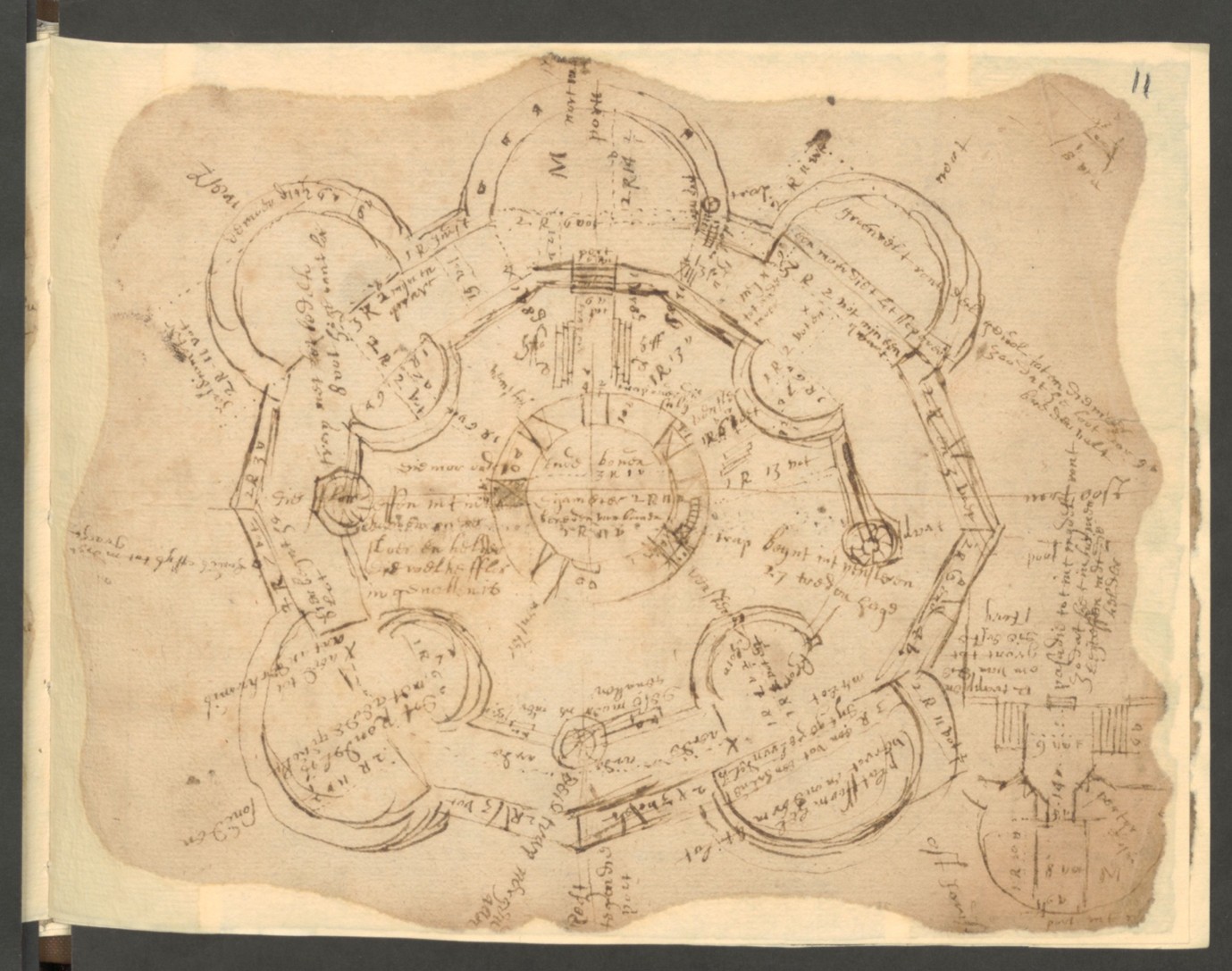
We will give you here two examples from Camber Castle. We have included the engineer’s full sketch plan here but will zoom in on the central keep. Having spent several months with this engineer and his handwriting, it can feel like we know the man quite well. He was often in a rush. This is visible in the way he sometimes repeats the same word in a row, and the density of abbreviations used. In the early modern period, abbreviations were common, and were themselves often standardised. For example, yt for that, or Sr for sir. These could be marked in several ways, but most often in either superscript or with a line above the word. Our engineer liked to break with tradition and places a characteristic C above a word. In my years working as palaeographer, I have never come across this, so we can reasonably conclude that this engineer was not formally trained. That is to say, he did not go to university; for most of the early modern texts that we work with, the authors had received a formal education and conform to the ‘rules’ of writing, but our engineer had worked out his own system of noting deviations. In a similar break with tradition, he uses the C symbol in three ways: to mark an abbreviation, to flag where he has made a mistake, or to indicate an English word and that he does not know how to spell it. Which one of these is the case for individual words is up to us to find out.

Image of Camber Castle from manuscript SP9/ 99. Copyright Paul Pattison

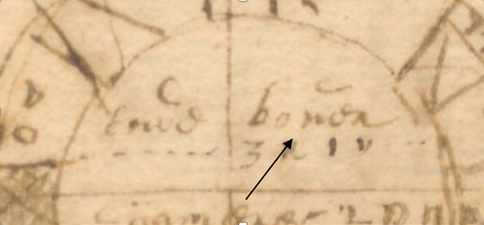
In the image below, there is a good example of the difficulty of these abbreviations or deviations. In the keep of Camber castle, there is written ‘ende boven, …… 3r 1v’. We know there is something strange going on with the word ‘boven’ because of the symbol C. To confuse matters further, this handwriting uses the same letter for v and n, and its e is often written as an o. We therefore assumed that this word would be an abbreviation of ‘benen’ (sometimes written as benéen), meaning ‘beneden’, which is Dutch for beneath or underneath. However, after working on several castles, it did not make sense that he would be talking about a roof beneath a room, and we therefore had to revisit all instances of benen and realised in some cases it had to be ‘boven’, meaning above. In this case the C symbol merely signifies the confusion between n and v, that the engineer himself clearly also suffered from.

Camber Castle image close up from SP9 / 99. Copyright Paul Pattison, National Archive Kew

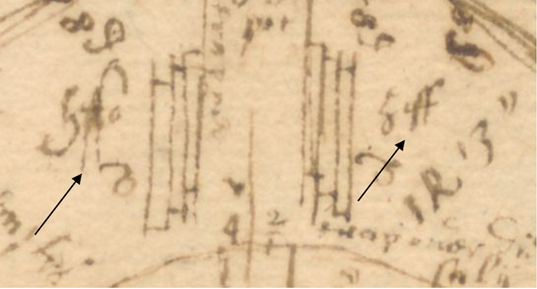
To give an example of the engineer’s haste, or possibly enthusiasm, we can turn now to the marks just above the word ‘boven’ in the previous image. As is clearly visible from the full photo of Camber castle, this was a gifted draftsman. Camber Castle is certainly not the most technically difficult of the castles in the manuscript, but, as ever, his attention to detail and scale is impressive. The care he took in the drawing itself is not always present in his annotations, presumably because these were in draft form. As a result, the distinction between what is part of the drawing and what are notes that were added later is blurred. In the below image on the left, there is a strange mark which can be transcribed as ‘hffo’. This is not even close to an early modern Dutch word. The h also misses its characteristic full loop in the bottom curve. We thought it might be an abbreviation, although the C-symbol is not present, or some sort of mark highlighting an element of the building. It was only after we went over the full transcription several times again, that we realised he had misspelled ‘hoff’, like the word on the right, meaning ‘courtyard’ in Dutch. In his rush he had jumbled the order of the letters and not fully closed his h.

Camber Castle image close up 2 from SP9 / 99 at National Archives, Kew. Copyright Paul Pattison

These moments of breakthrough are rather exhilarating. Most of the transcriptions and translations that we have made still have some outstanding ‘curiosities’ to be solved. However, as a result of these idiosyncrasies or oddities, we have been drawn very close to the material and grappled with all aspects of it: the material history, the background of the engineer, the process of surveying these castles and fortifications, and the long history of repair. We are now in the process of puzzling over the new information the survey has brought to light and how it fits with what we already know about these buildings. We look forward to disclosing further updates here, hopefully in fully legible modern English.

Subscribe to our quarterly newsletter

Dalkeith: Duchess Anna’s Old Castle

In the first of two articles Dr Cristian Clarkson, Heritage Consultant at Simpson & Brown takes a look some of the work she has done at various castles during her time with the firm.

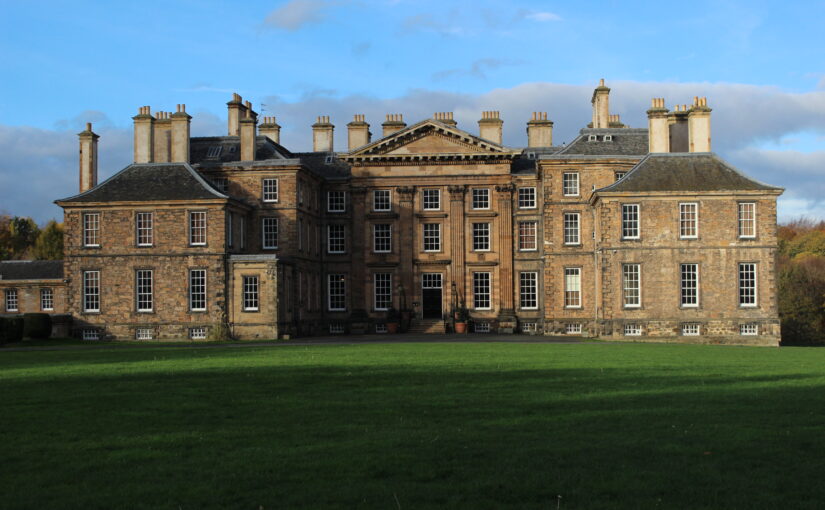
The exterior of Dalkeith Palace is easily accessible to visitors, standing within a popular country park south-west of Edinburgh. Its interiors, however, have been largely hidden away since its construction for Anna, Duchess of Buccleuch, in the very early eighteenth century, and it has been relatively little-studied. Duchess Anna commissioned a radical remodelling of Dalkeith Castle, the Buccleuch family seat, from architect James Smith, and the family used the house for two hundred years. Clumsily converted for office use in the 1970s, and then used as the study-abroad centre of the University of Wisconsin from the 1980s, the building was vacated in 2021 and new uses are currently being evaluated by the Buccleuch Estate. Simpson & Brown completed a conservation plan for the building in 2024, one of the key questions of which was how far there were remains of Dalkeith Castle within the Palace, and what that castle was like.

Subscribe to our quarterly newsletter

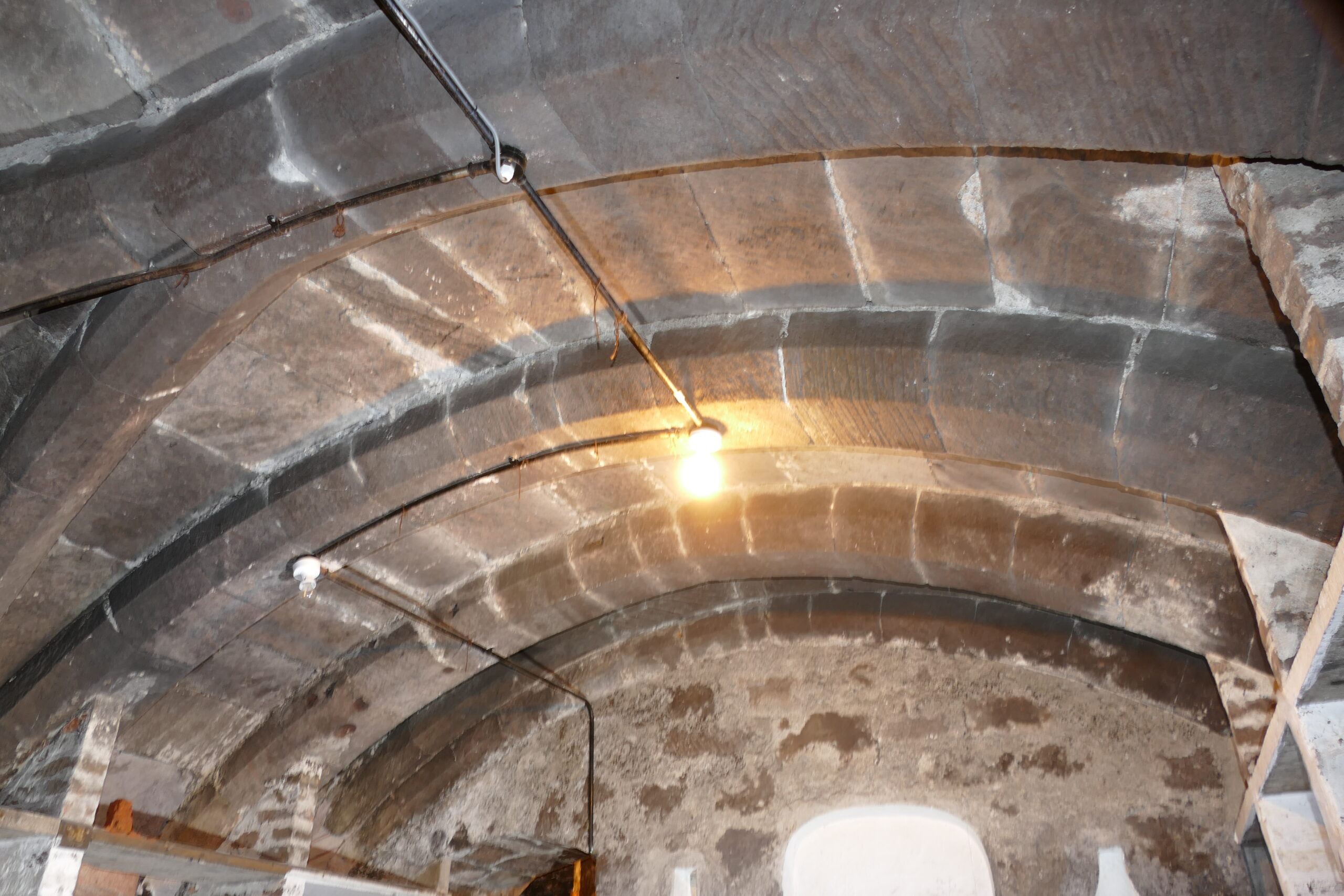
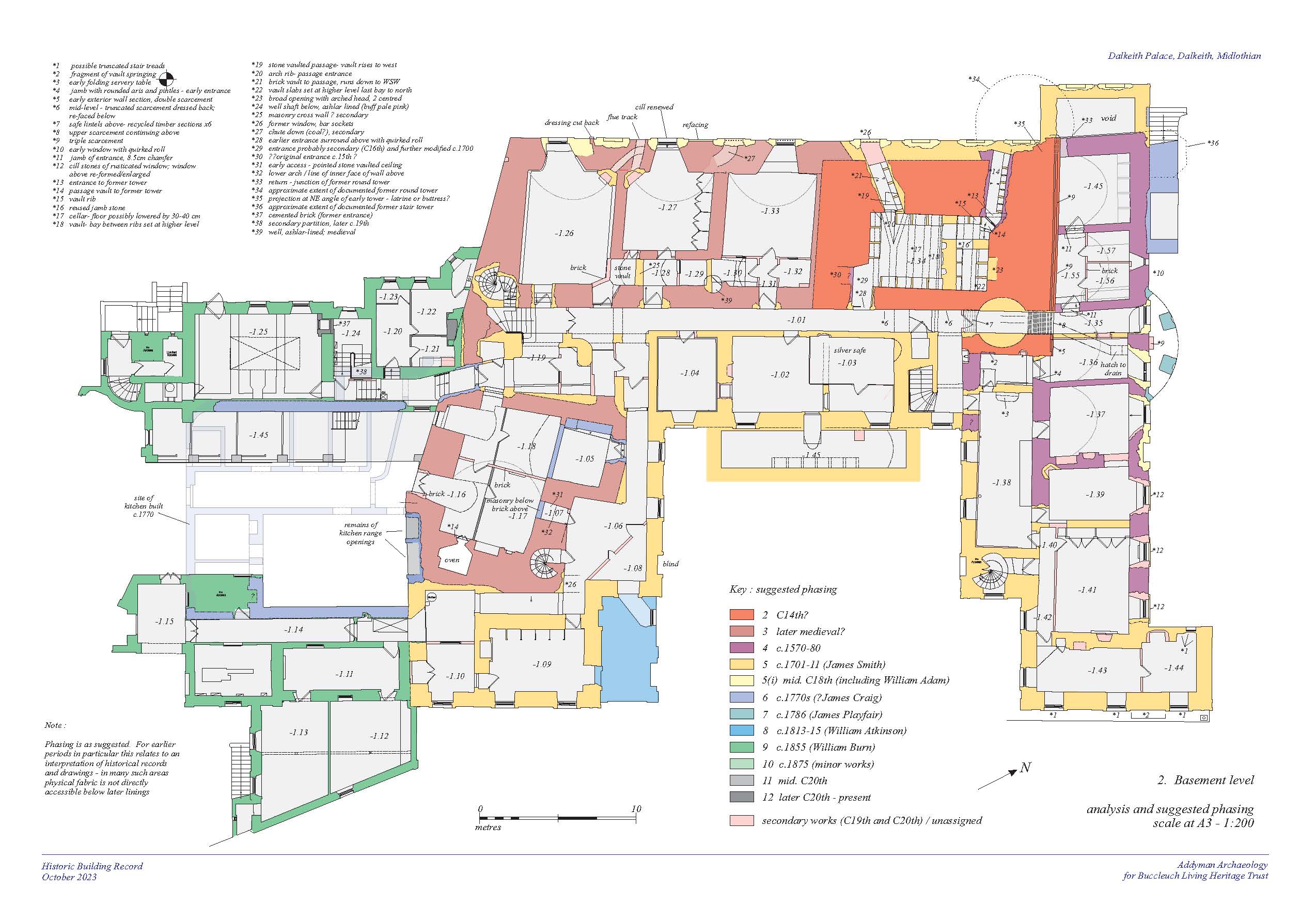
Dalkeith Castle probably originated in the fourteenth century as a Douglas fortification, and was expanded by the 4th Earl of Morton in the sixteenth century. It was bought by the Scotts, then Earls of Buccleuch, shortly before the Wars of the Three Kingdoms in the seventeenth century, and passed to Anna Scott in 1661 when she became Duchess in her own right. The fact that there is at least some medieval fabric remaining at Dalkeith is clear: there is a rib-vaulted basement room in the north range, at the centre of an area of very thick walls. There is also an asymmetry in the Palace’s plan: although the south entrance front is highly regular, the west range in fact meets the north range at an angle, immediately suggesting the re-use of earlier fabric. Several locked voids in the plan of this range suggest the historic presence of a kitchen with large flues which were blocked by James Smith.

Basement of North Range at Dalkeith Palace, copyright Simpson Brown

There are two key images of the historic castle: Slezer’s engraving (incorrectly labelled Glamis in his publication), and an unnamed, undated plan held in the Buccleuch collection which shows one storey of the castle. Slezer shows a castle built around two courts, with the inner court on three sides replicating the plan of the existing Palace. At the north-east corner, a tower over three or four storeys with bartizans and pedimented window-surrounds stands over the existing vaulted cellar, while a low range to the west must contain the historic kitchen. On the east side, there is a regular range which stands where there are barrel-vaulted cellars in the present Palace. The plan shows a turnpike stair where there are now empty round rooms at each level in the former stairwell, and a scale-and-platt stair on the same location as the existing state stair. At the north-east corner of the castle there is a projecting round tower shown which almost survived to the present building, as later documents show.

Phased Plan of Dalkeith Palace, copyright Simpson Brown

Little is known about the castle’s interiors, but there was something to be gleaned from the huge wealth of documentary evidence relating to Duchess Anna’s rebuilding. The Buccleuch archive, held partly in the National Records of Scotland, includes many receipts for work on the building. Although the majority of these are for the new eighteenth-century fabric, there are some which relate to cosmetic renovations on the old castle: the Duchess travelled north after decades in London to stay in the castle, meet James Smith and sign contracts for the rebuild, and the house needed some work in advance of her stay. Invoices for plastering list the rooms of the castle, including ‘the great painted room’, as well as ‘the King’s room’ with an adjacent study; these entries are arranged by floor and give some suggestion of the location of these rooms within the building. They also give clues as to which rooms were retained: one room listed is known as the ‘stone hall’, and a room with this name appears consistently in invoices for work in the new building as well. It is probably the vaulted room above the kitchen, used by the steward.

We also examined a series of design development drawings by James Smith, in which he helpfully shades fabric to be retained in the new house. None of these drawings are exactly as-executed (William Adam’s plans in Vitruvius Scoticus are the closest to the finished house), but show that initially Smith hoped to raze the old palace and eventually retained a great deal of the castle at basement and ground levels. There appear to have been particular difficulties around the north-east corner, where the plans were to retain the existing round tower; this was not carried off in the final design and would have made an interesting companion-space to the exquisite neighbouring ‘picture closet’ with its elaborate parquet floor and painted mirror by Jakob Bogdany. Smith also workshopped an option where the original re-entrant stair would be retained with a new branch down into the entrance hall, but this was not executed.

The Buccleuch archive also contains the details of a court case between Smith and the Duchess after the completion of the building, which reveals some of the decision-making process behind the retention of castle fabric. The Duchess complained that the building was poorly constructed, with cracks in the walls and chimneys which smoked: Smith blamed the Duchess for insisting that he keep old masonry rather than building anew. Presumably her primary motivation was financial, but her letters reveal a certain sentimentality for her childhood home, which she left after her father’s death and before her marriage to the Duke of Monmouth. She wrote to a friend that he might think she was extravagant in fitting out her new house with marble, ‘but it is to shew you I do not Dispyse my old Castle.’

Subscribe to our quarterly newsletter

Pembroke Castle: Elite Use of Outer Ward Space

Buildings archaeologist, Neil Ludlow, gives an update of the work that has been done since the Trust funded two projects at Pembroke Castle.

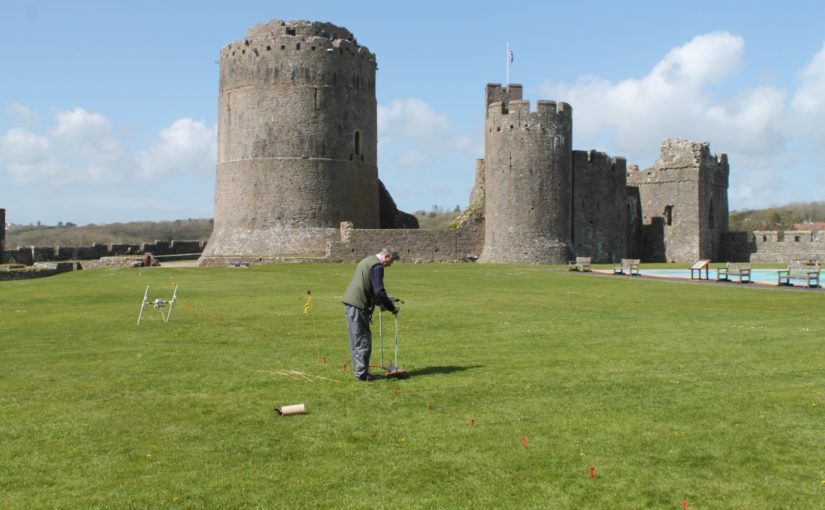
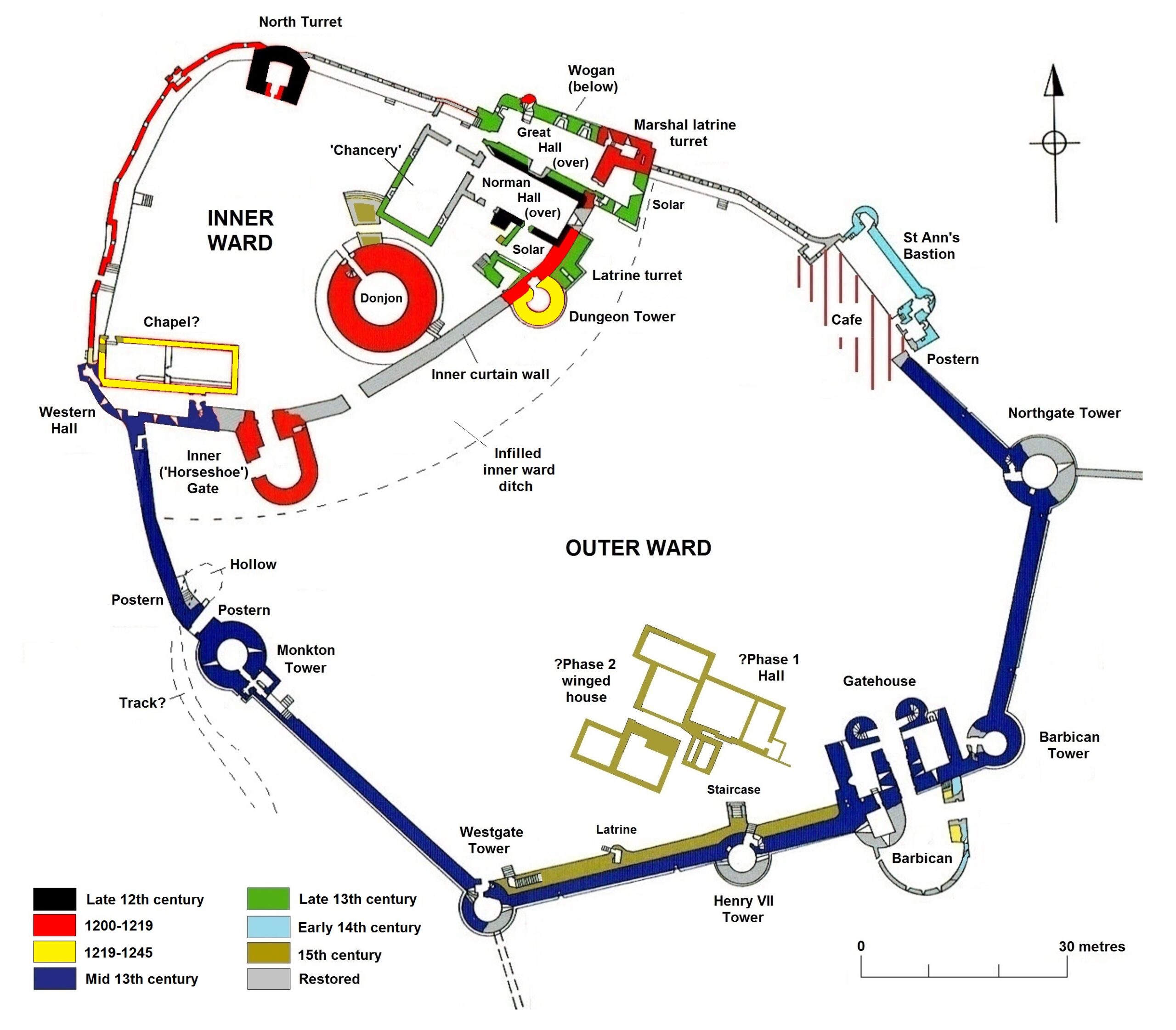
Two CST-funded projects, in 2016 and 2018, looked at a late-medieval building complex in the outer ward at Pembroke Castle (Day and Ludlow 2016; Meek and Ludlow 2019). All above-ground remains of the buildings have gone, but vestiges of walling are marked here on a plan from 1787, while a drawing from 1802 appears to show a surviving doorway. The buildings were part-excavated in the 1930s, but sadly without record. However, the presence of walls, floors and stairs was noted, and a cess-pit from which was retrieved a Limoges-enamelled bronze fitting of late thirteenth/early fourteenth-century date. The wall-lines show as strong parchmarks in dry summers (see Fig. 1).

Subscribe to our quarterly newsletter

Figure 1: Phased plan of Pembroke Castle, copyright Neil Ludlow

The spacious outer ward was added to Pembroke Castle in the 1240s-50s, and appears to have been an entirely new enclosure. It was not ditched, the limestone bedrock instead being levelled as a platform to receive the curtain walls. And a flanking tower, the so-called ‘Dungeon Tower’, had been built against the inner curtain only 20 years previously, implying that it was still a forward line of defence. Moreover, it subsumed part of the town as at Swansea (Glam.) and Ludlow (Shrops.). Geophysics by Dyfed Archaeology in 2016 suggested it was largely an empty space, perhaps intended for ‘civil’ assembly, military gatherings, pageantry/display or leisure – or perhaps all four. By the early fourteenth century, it appears to have contained a garden and it may always have been perceived as ‘gentrified’ space, rather than seeing the kind of purely functional use that is normally ascribed to outer enclosures (Ludlow 2017).

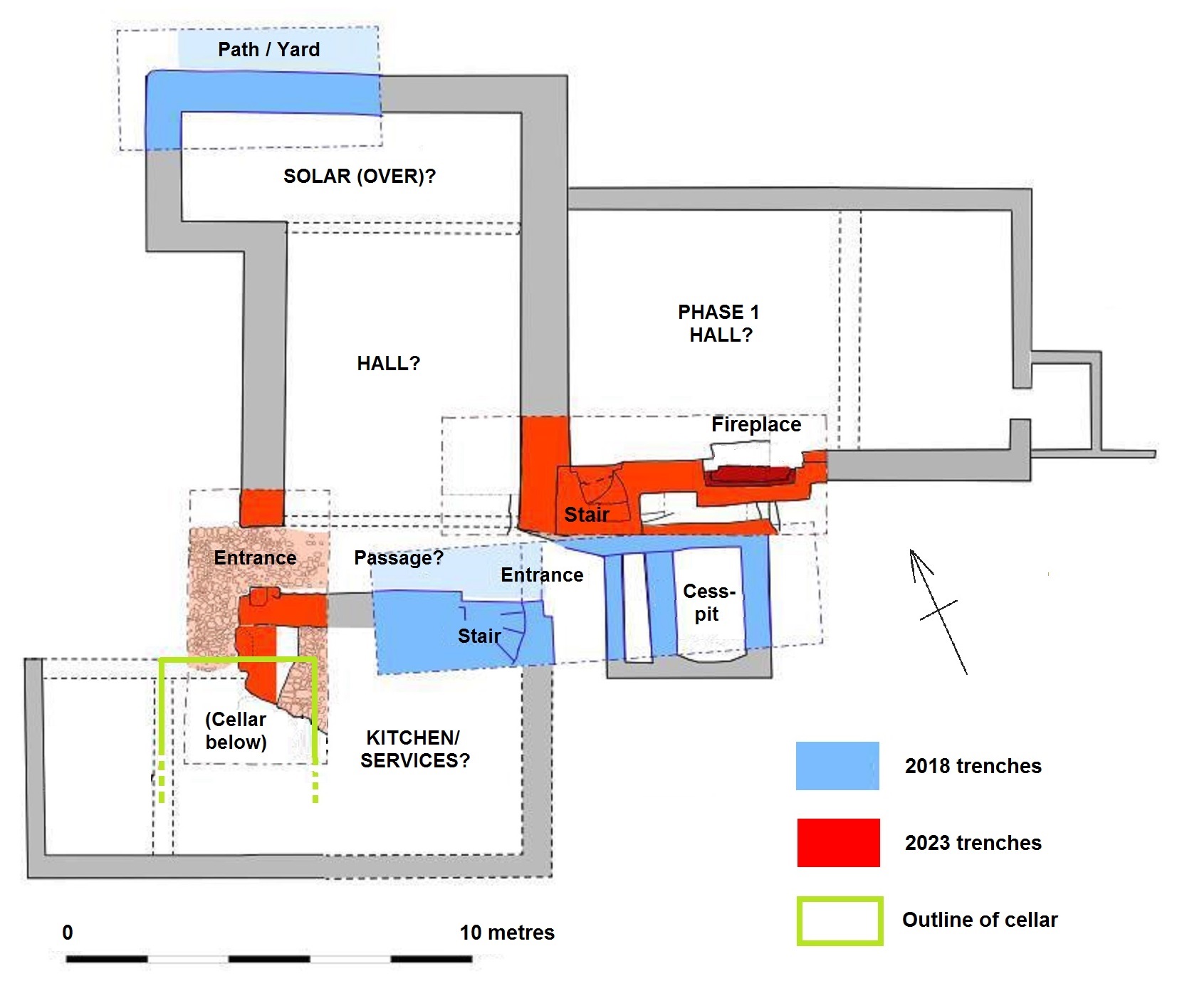
So the complex, which was clearly substantial, was interpreted as high-status and residential: taken along with the parchmark evidence, the geophysics appeared to indicate a substantial, winged hall-house, with a possible yard to the southeast conjoined with a further, smaller building. Two trenches were excavated across the winged house in 2018, by Dyfed Archaeology, revealing walling, a helical mural stair, and the cess-pit exposed in the 1930s (Fig. 2). The excavated area was limited and the full layout of the complex not revealed. Neither was close dating evidence forthcoming.

Two more trenches were dug in 2023, again by Dyfed Archaeology but this time funded by the Pembroke Castle Trust (Poucher 2025). They produced a couple of big surprises. Firstly, a cellar was revealed beneath the southern wing of the hall-house. And what had been interpreted as an open yard, to the southeast, was revealed to be another roofed building, with a lateral fireplace in its south wall (Fig. 2). The base of a further mural stair was exposed in the same wall. The physical relationships showed that this building pre-dated the winged hall-house, but close dating evidence was again slight.

Figure 2: Plan of the excavation trenches over the hall-house (adapted from Poucher 2023). The winged house to the southwest (left), overlying a cellar, appears to be secondary to the open Phase 1 Hall.

While only four small trenches have been dug, and the site is still very little understood, we can perhaps propose a conjectured sequence. Its scale and location show the house to have been an elite structure from the first. On current evidence, it appears to have begun as a large, free-standing hall, with an attached, storeyed unit at its southwest end overlying a barrel-vaulted cellar; the latter is of a regional form similar to late-medieval cellars that still survive below properties in Pembroke town. This end unit was subsequently replaced with, or adapted into, a winged house that was apparently self-contained: it appears to have comprised a central space (another hall?), associated with the cess-pit and flanked by storeyed wings; the upper floor of the southern wing was accessed via a helical stair.

Comparison with similar buildings, and the sparse dating evidence, suggests both phases are fifteenth-century. By this time, the domestic buildings in the inner ward had a history of neglect, coupled with an increasing burden of administrative and penal machinery. The outer bailey was both quieter and emptier, and had perhaps always seen ‘elite’ forms of use, with at least one garden (later two); understandably, it might have been preferred for seigneurial residence. A similar development occurred in another caput castle, at Montgomery, where a mansion house was built in the outer enclosure during the 1530s.

Subscribe to our quarterly newsletter

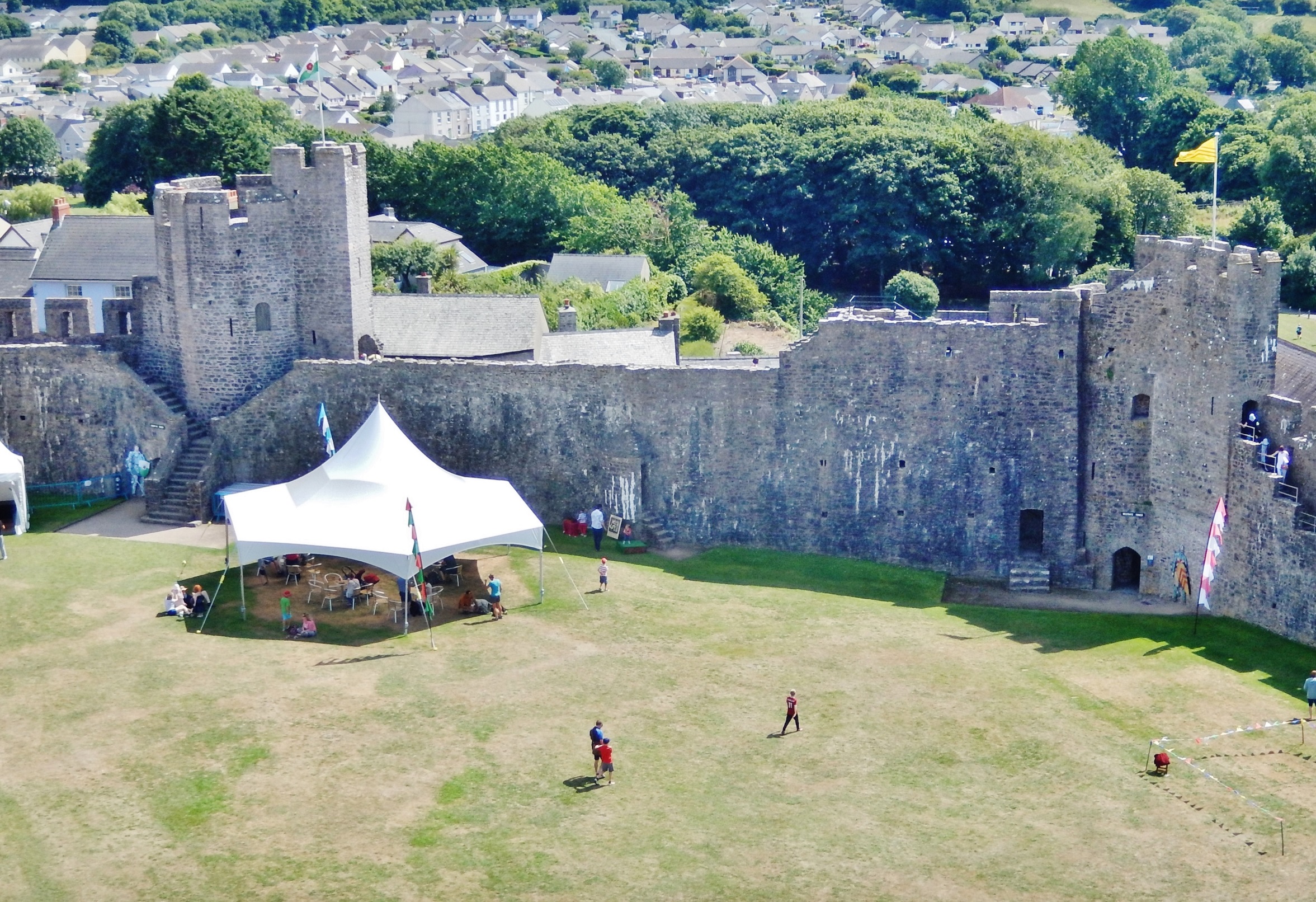
And the Pembroke house appears not to have sat in isolation. The south curtain wall has, at some period, been doubled in thickness with over two metres of masonry applied to its internal face (Fig. 3). This has long been regarded as a Civil War measure against artillery (see King 1978, 120), but an earth fill was normally chosen for this purpose, while the thin-walled mural passage lies on the exposed external face. I suggest this thickening belongs instead to the fifteenth century, to create a broad ‘promenade’ at parapet level. The use of parapets as promenades has been suggested at a number of castles, from the twelfth century onwards: they provided a viewpoint from which a lord could show off his domain to distinguished guests, while offering scope for high-status recreational use – particularly by women. The Pembroke parapet is approached by two staircases in the thickened section, both of a somewhat ‘processional’ nature. One, a mural stair, is long and straight, while the second wraps around the Henry VII Tower as a double flight of persuasively late-medieval form, and was clearly designed to be seen; it is not obviously military (Figs. 1 and 3). Lying immediately south of the house, it is accompanied by a second ornamental feature – a projecting porch, leading to a latrine within the wall-thickening. This porch, like the thickening, has traditionally been assigned to the Civil War period (King 1978, 94 and n. 75), but in overall form it is not unlike the corbelled oriels seen in later fifteenth-century domestic work (Figs. 1 and 3). Though substantially restored, all these features respect surviving physical evidence; together with a second garden mentioned in a source from 1481-2, they appear to represent a prestige suite of ‘eye-catchers’, clustered around and associated with the hall-house. It is likely, too, that use of the latrine itself was restricted by status and/or gender. The infilling of the inner ward ditch may belong to the same period, to create more seigneurial space.

Figure 3: The outer curtain wall from northwest, showing the double flight of stairs around the Henry VII Tower, to left, and the latrine porch at centre. The parchmarks of the hall-house are visible at bottom left.

Three candidates had the resources to build on this scale. It is possible that the Phase 1 hall was built by Humphrey Duke of Gloucester, earl of Pembroke 1413-47, for his personal use. His political influence was in decline by 1441, and he may have intended to use Pembroke as a regular residence, far from his powerful opponents: he appears to have already built a smaller hunting-lodge for himself, just over the river from the castle at Monkton. If so, it is possible that the Phase 2 winged house was added by Jasper Tudor, soon after he acquired the earldom in 1452, in anticipation of occasional visits and to announce his ‘arrival’ among the leading aristocracy. It might not, however, allow enough time for the promenade to be built: after 1454, and until 1461, the Wars of the Roses forced him into more-or-less permanent residence at Pembroke, but in an environment that may militate against such overtly domestic work. Jasper seems moreover to have rarely visited Pembroke after the war, when he concentrated on his favoured castles at Sudeley and Thornbury in Gloucestershire. It may then be that the winged house and promenade were added by the Yorkist leader William Herbert the elder, who held Jasper’s forfeit lands between 1461 and 1469. His work at Raglan in Monmouthshire, where the castle was transformed into a magnificent palace, shows him to have been an ambitious builder.

Subscribe to our quarterly newsletter

References

Day, A. and Ludlow, N., 2016 ‘Pembroke Castle Geophysical Survey 2016’ (report by Dyfed Archaeological Trust for the Castle Studies Trust: see –

http:/castlestudiestrust.org/docs/Pembroke_Castle_Geophysical%20_Survey_FINAL.pdf).

King, D. J. C., 1978 ‘Pembroke Castle’, Archaeologia Cambrensis 127, 75-121.

Ludlow, N., 2017 ’Medieval Britain and Ireland, Fieldwork Highlights in 2016: Pembroke Castle outer ward – gentrified space and Tudor Mansion?’, Medieval Archaeology 61/2, 428-35.

Ludlow, N., forthcoming ‘Two baronial castles in Pembrokeshire: Picton and Pembroke’, Journ. British Archaeological Association 178.

Meek, J. and Ludlow, N., 2019 ‘Pembroke Castle: archaeological evaluation, 2018’ (report by Dyfed Archaeological Trust for the Castle Studies Trust: see – http://www.castlestudiestrust.org/docs/Pembroke_Castle_Evaluation_2018_FINAL.pdf.

Poucher, P., 2025 ‘Pembroke Castle: archaeological evaluation, 2023’ (report by Heneb – Dyfed Archaeology, report no. 2023-33).

Echoes from the Earth: A Community-Led Archaeological Project at Crookston Castle

Chair of the Friends of Crookston Castle, David McDondald and Historic Environment Scotland’s Dr Hazel Blake look forward to the community geophysical survey days that are starting on Friday that the Trust is funding.

Subscribe to our quarterly newsletter

As Glasgow celebrates its 850th anniversary, the Friends of Crookston Castle are proud to be contributing to the city’s story with a major new heritage project.

Re-established in 2024, our volunteer-led group exists to care for and celebrate Glasgow’s only surviving medieval castle, Crookston.

Crookston Castle copyright Friends of Crookston Castle

Once surrounded by ancient woodland the Castle is now encircled by twentieth-century housing. It has stood as a landmark in the life of generations of local people, but many of them do not realise just how deep its history runs.

That’s why we’re excited to be launching Echoes from the Earth – Crookston Castle’s Hidden Stories, supported by the Castle Studies Trust.

At the centre of the project is a three-day geophysical survey, the most comprehensive investigation of the site in decades. The survey will use three techniques; gradiometry, earth resistance, and ground-penetrating radar to build a picture of what lies beneath the castle grounds and the surrounding area.

With the help of Historic Environment Scotland, local volunteers will be trained to use the archaeological equipment providing our partner schools with a unique learning experience, while boosting the skills of early career archaeologists and local students. Crookston Castle is an unusual stone castle built around 1400 within earlier earthworks constructed in the 1100s. It is the only surviving medieval castle in the City of Glasgow and is in the care of Historic Environment Scotland (HES; Crookston Castle | Public Body for Scotland’s Historic Environment). 

The site is a well-known local landmark and has an active ‘Friends of Crookston Castle’ group from the local community who value the monument as an important part of their historic environment. Working in partnership with the ‘Friends’, the archaeological survey team at HES will be undertaking geophysical survey at Crookston Castle. This has two main objectives – firstly to understand more about what may lie below the ground surface, and secondly to provide experience of geophysical survey to the Friends of Crookston and support them in finding out more about their monument.

Subscribe to our quarterly newsletter

At any stone-built castle, it is inevitable that impressive standing masonry is a focus of attention. But these were monuments that underwent changes and development, perhaps because of war damage or as needs changed, and may be one aspect of a much longer span of activity on the site. So, there may be more to them than immediately meets the eye. The planned gradiometer, earth resistance and ground penetrating radar surveys (see here for more information on these techniques) will provide views of what archaeological remains lie below the ground surface. We hope this will provide more information about the history of the castle, enriching the stories that the remains can tell us and informing future management of the site.

Crookston Castle, copyright Friends of Crookston Castle

Crookston Castle matters to the local community, and that is one reason why it is important to HES to be working with the ‘Friends’ to better understand their monument. By providing experience of geophysical survey and the interpretation of the results, we have an opportunity to share experience and knowledge and together contribute to a better understanding of the site now and in the future.

Geophysics is exciting because you never know what may pop up in the survey data, lurking unsuspected under the ground surface! But there are already two potential areas of interest that we know should benefit from survey. One area to the south of the stone castle may contain medieval activity, while to the west there is what may have been the original western entrance. Both areas will be an initial target for the geophysical survey, with flexibility to target further areas across the site.

Crookston Castle is valued by its local community. It is a great opportunity for HES, as the national publicly funded body for the historic environment, to be able to engage directly with the Friends and support them in their interest in the monument. 

Subscribe to our quarterly newsletter

If you would like to get involved with the group, get in touch at Crookstoncastlefriends@gmail.com and follow them on Facebook.

So, if Crookston is close to you and you’d like to get involved in the project, get in touch or follow our progress on our social media and help us unearth the history and stories of a site that even after all these years still has secrets to share and that continues to surprise us, inspire us, and to remind us that the past is never quite as far away as it seems.

Medieval Greece – A Forgotten World

Project lead of the 2022 project Dating the Medieval Towers of Chalkida, Greece, Dr Andrew Blackler, gives an update on how work on the project has progressed.

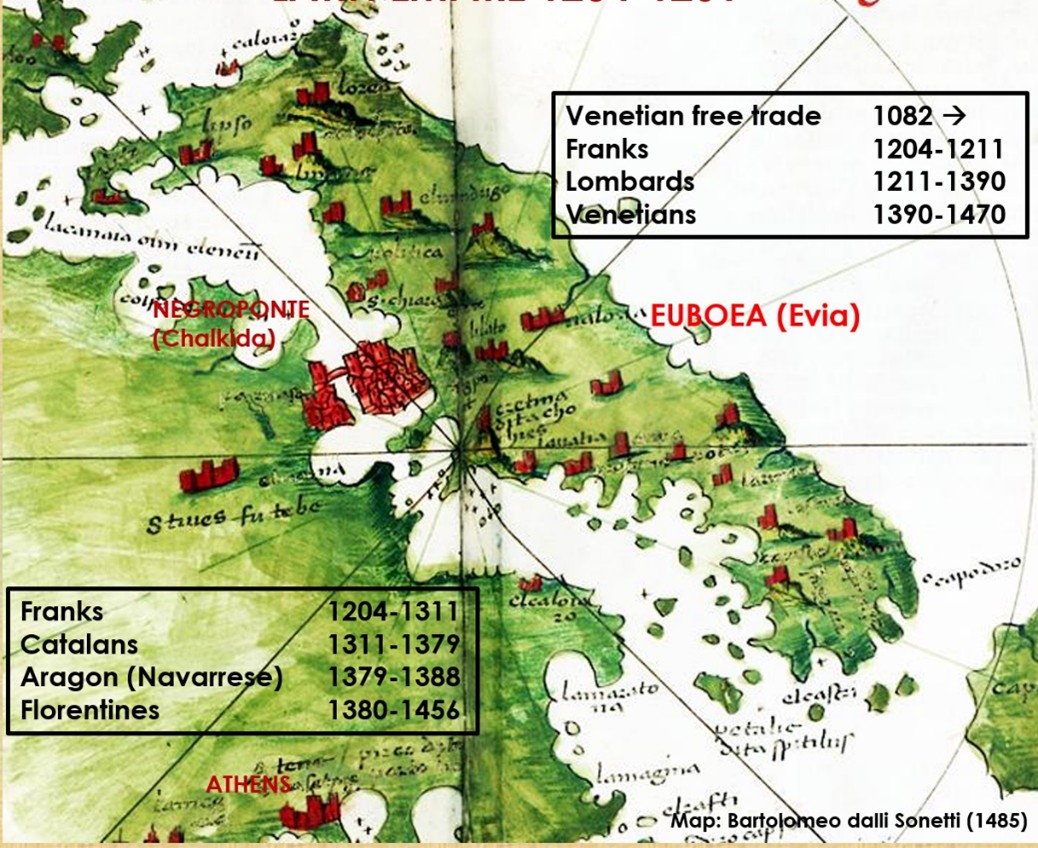
Mention the Acropolis to anyone and they will probably immediately identify it with Greece. Yet the Norman invasions of Greece just fifteen years after the battle of Hastings are almost unknown. Few will know too that the magnificent horses adorning St Mark’s Basilica in Venice were pillaged from Constantinople in 1204, and that much of Central Greece and its islands were ruled for nearly three hundred years by a succession of western adventurers from as far away as Catalan Spain, until the region’s annexation by the Ottoman empire at the end of the fifteenth century. This is simply illustrated in the figure below, based on a map of Central Greece by the Venetian cartographer Bartolomeo dalli Sonetti c.1485. at a time when Athens was just a small provincial town whilst Negroponte was a major city.

Subscribe to our quarterly newsletter

Figure 1: Three Centuries of Western Rule

This is the background to the five-year survey of the hinterland of medieval Chalkida (Negroponte) on the island of Evia (Euboea), which I was invited to join by Professor Joanita Vroom of the University of Leiden Dr Alexandra Kostarelli of the Ephorate of Antiquities of Euboea in 2020 – the first major archaeological survey in Greece to focus exclusively on the medieval period. Initially, times were tough as the COVID shutdown and lack of funding restricted our work, but slowly our team established a track record supported by sponsorship from institutions such as the Castle Studies Trust (2022).

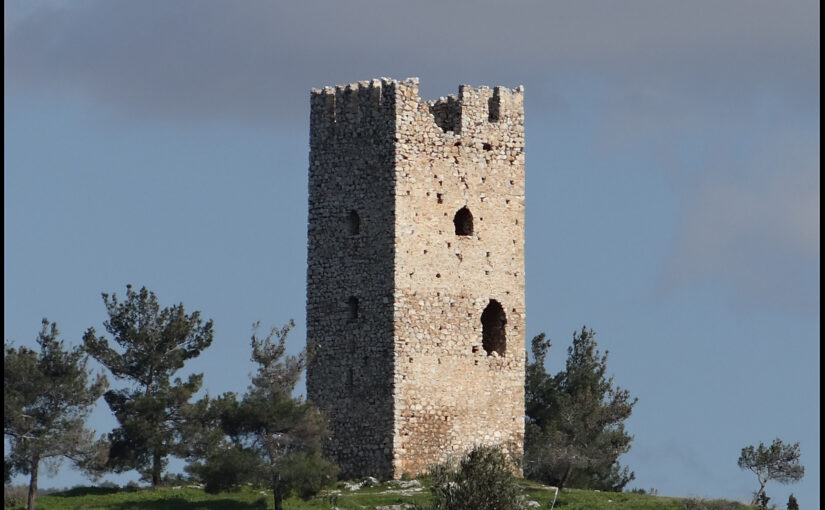
This project, in conjunction with the National Centre of Scientific Research laboratory at the University of Athens, undertook the radiocarbon dating of sections of wood taken from within the walls of a group of medieval towers, a ubiquitous feature of the region. It was very successful. For the first time we were able to conclusively prove that the more than one hundred towers, that once stood on the island, were not built immediately after 1204 as part of a colonial process of control and exploitation, but during the fourteenth century, probably to protect local villages against pirate attack from the sea, an endemic problem of the era.

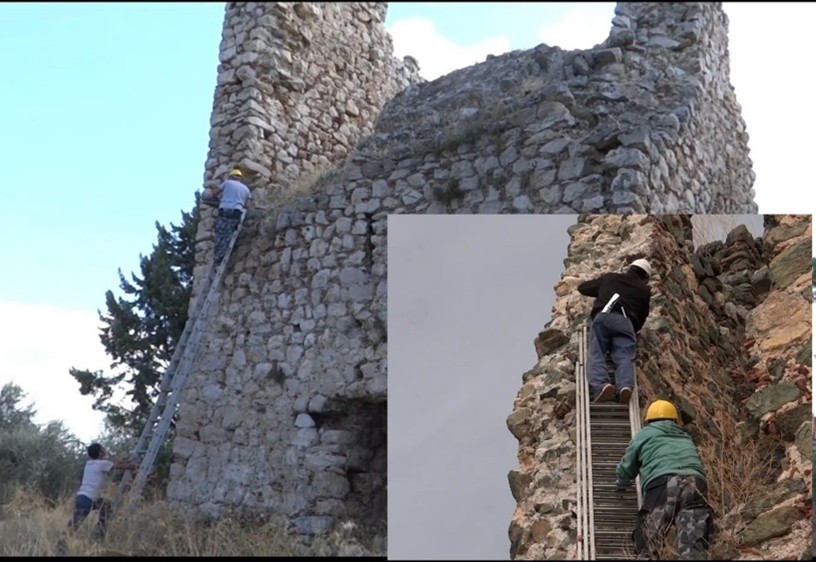
Figure 2: Taking wood samples from a tower, copyright Dr Andrew Blackler

During five years of work over the summer months our team of over thirty specialists and student volunteers has now recorded all the known medieval monuments of the region. Using intensive surface survey techniques and trial excavation trenches, evidence from ceramic, coin, glass, iron, fauna and bone finds is slowly allowing us to reconstruct a picture of the medieval life of the region. Trading links have also been identified east as far as the Black Sea and Palestine, and west to other centres around the Mediterranean. More recently, we have attracted major sponsorship and are now undertaking geophysical surveys to identify structures hidden under the earth, digital reconstruction of selected monuments and have even instituted a second phase of radiocarbon dating. In parallel, specialists have been investigating the medieval archives of the Republic of Venice and Ottoman administrative records held in Istanbul. A detailed report of the results of the first two years’ survey campaigns can be found at https://poj.peeters-leuven.be/content.php?url=article&id=3293423&journal_code=PHA&download=yes

I will leave you with a final thought: the medieval world, despite the slow pace of travel, was much more inter-connected than people generally believe. Two examples illustrate this. Many know that Harald Hardrada, king of Norway and the last great Viking, invaded England in 1066, and was killed at Stamford Bridge just weeks before the battle of Hastings. Few realise that he made his fortune fighting for over ten years in the elite Byzantine Varangian Guard, and that this had probably helped fund his claim to the Norwegian throne. Recent analysis of finds in the British Museum from Sutton Hoo also suggests that Anglo-Saxon mercenaries were even fighting alongside the Byzantine emperor Justinian in Asia Minor as early as the sixth century. This is the sort of international research that the ‘seed capital’ provided by the Castle Studies Trust has spawned over the last three years.

Subscribe to our quarterly newsletter